Key Takeaways:
The best email marketing services in 2026 range from free starter plans to enterprise-grade automation suites. Your budget and list size will guide the right pick.
Deliverability, automation depth, and ease of use are the three factors I weighted most heavily in my testing.
Free plans from Brevo, MailerLite, and Sender give you real features without spending a cent, making them ideal starting points.
Platforms like ActiveCampaign and HubSpot suit growing teams, while beehiiv and Kit are purpose-built for newsletter creators.
Email remains one of the highest ROI marketing channels available. With 5 billion email users projected by 2026, getting your platform right matters enormously.
I have run the leading email marketing services through trial accounts, test sends, and their published pricing pages across different business sizes, budgets, and use cases.
If you’re scanning this to find the right platform fast, here’s my honest take: the “best” service depends entirely on your situation.
One platform suits a solo blogger; a completely different one fits a 10-person ecommerce team.
I’ll walk you through every major option so you can stop guessing and start sending.
Best Email Marketing Platforms Overview for 2026
Before getting into individual reviews, here’s a quick comparison table I built while working inside each platform.
These are the platforms I evaluated most thoroughly, covering features, pricing, deliverability, and the overall experience of actually using them day to day.
| Platform | Best For | Starting Price | Free Plan? |
|---|---|---|---|
| MailerLite | Beginners | $9/mo | Yes |
| Brevo | Free email marketing | Free/$25/mo | Yes |
| ActiveCampaign | Marketing automation | $15/mo | No |
| beehiiv | Newsletter creators | Free / $42/mo | Yes |
| Moosend | Small businesses | $9/mo | Trial only |
| HubSpot | All-in-one marketing | Free/$20/mo | Yes |
| Omnisend | E-commerce | Free/$16/mo | Yes |
| Kit (formerly ConvertKit) | Creators and bloggers | Free/$29/mo | Yes |
| Mailchimp | All round use | Free/$13/mo | Yes |
| GetResponse | Funnels and webinars | $19/mo | Free tier |
What to Look for in an Email Marketing Platform
When I first started evaluating these tools, I nearly got distracted by flashy dashboards and feature lists.
Here’s what actually matters when picking your platform.
Deliverability rates and inbox placement
No feature matters if your emails land in spam. I prioritize platforms with strong sender reputations and dedicated IP options.
Mailchimp maintains an average email deliverability rate above 99%, which sets a solid benchmark. Look for platforms that publish their own deliverability data openly.
Automation depth and ease of setup
Automation is what keeps selling while you sleep. The fastest route from signup to results runs through a well-built welcome sequence and a few behavioral triggers.
Platforms like ActiveCampaign let you build complex, multi-step journeys. MailerLite keeps automation simpler but accessible for beginners.
Pricing transparency and free plan value
Some platforms advertise a free plan, then lock the features you actually need behind a paid tier.
I tested each free plan myself to check what’s genuinely usable without upgrading.
Template quality and design tools
Your emails represent your brand. Poor templates make even good content look cheap.
I rated each platform’s drag-and-drop editor and template library based on visual quality and mobile responsiveness.
Segmentation and personalization
Sending the same message to your entire list means writing for an average subscriber who does not exist.
Strong segmentation tools let you tailor messages based on behavior, purchase history, location, and more.
15 Best Email Marketing Services in 2026
1. MailerLite: Best for Starting with Email Marketing
MailerLite is the platform I recommend most often to people just getting started.
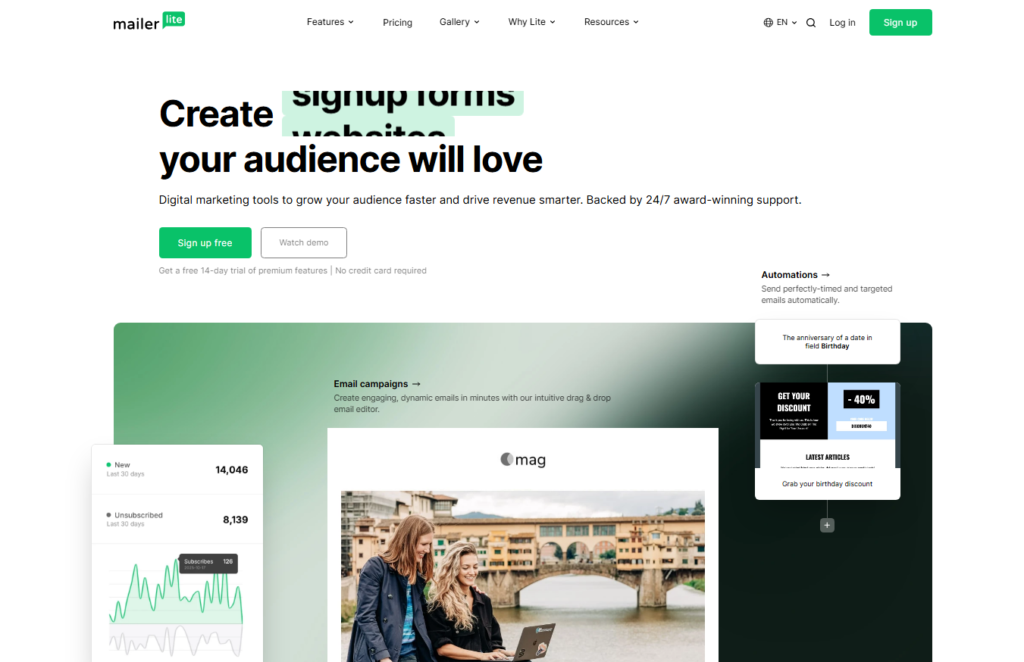
The interface is clean, the learning curve is gentle, and the free plan covers up to 1,000 subscribers with 12,000 monthly emails. That’s a genuinely useful starting point, not a teaser.
When I set up my first automation inside MailerLite, I had a working welcome sequence live within 20 minutes.
The drag-and-drop editor is fast and produces mobile-ready emails without any code. The reporting dashboard shows open rates, click-through rates, and unsubscribe trends clearly.
MailerLite’s landing page builder is also surprisingly capable, even on free plans, which almost no roundup bothers to check.
You can capture subscribers without needing a separate landing page tool.
Pricing: Free up to 1,000 subscribers. Paid plans start at $9/month.
2. Brevo: Best for Free Email Marketing
Brevo (formerly Sendinblue) prices by emails sent per month rather than by list size.
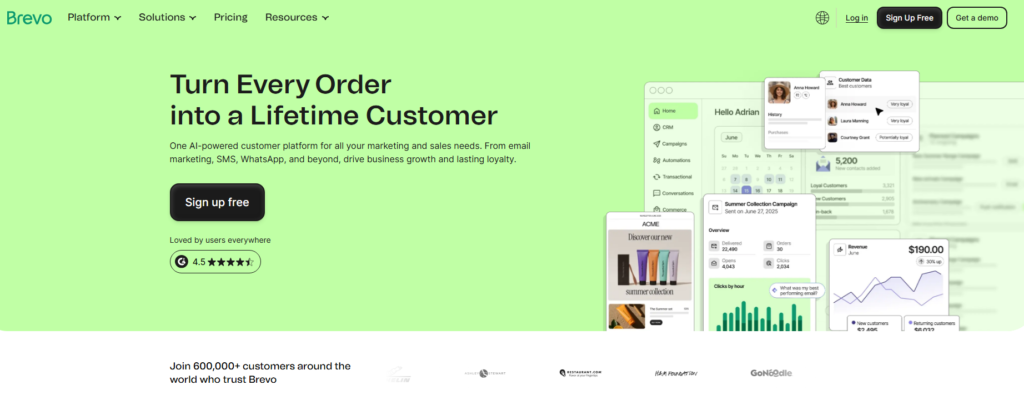
That makes it genuinely affordable for businesses with large lists but moderate sending volumes.
The free plan gives you 300 emails per day with unlimited contacts.
What impressed me most during testing was the automation available on the free tier.
You can build multi-step workflows, set behavioral triggers, and even run SMS campaigns from the same account. Most competitors lock automation behind paid plans.
The ceiling shows up fast: the daily send limit on the free plan (300 emails) can feel restrictive when you’re ready to run a campaign to your full list.
Pricing: Free forever plan. Paid plans start at $25/month.
3. ActiveCampaign: Best for Marketing Automation
ActiveCampaign is where I send teams that need serious automation power.
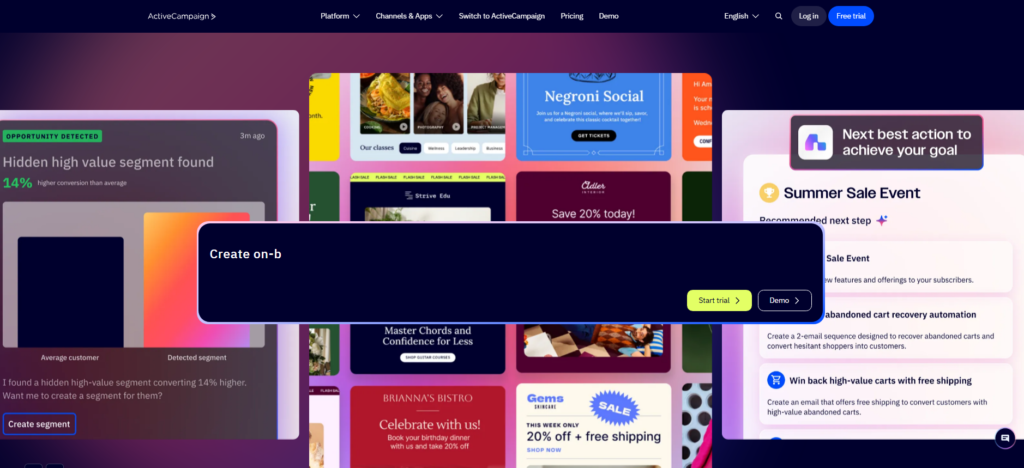
The visual workflow builder handles complex branching logic, conditional splits, and CRM-integrated follow-up sequences.
MailerLite covers the basics. ActiveCampaign is built for people who need every branch mapped out.
The platform’s contact scoring, site tracking, and predictive sending features are genuinely advanced.
I tested a re-engagement campaign using site activity triggers, and the results beat a simple time-based drip by a wide margin.
The reasoning for the higher price tag: you’re paying for infrastructure that scales with you.
Startups might find it overkill; mid-sized businesses will find it worth every cent.
Pricing: Starts at $15/month for up to 1,000 contacts.
4. beehiiv: Best for Newsletters and Monetization
beehiiv was built specifically for newsletter publishers, and it shows.
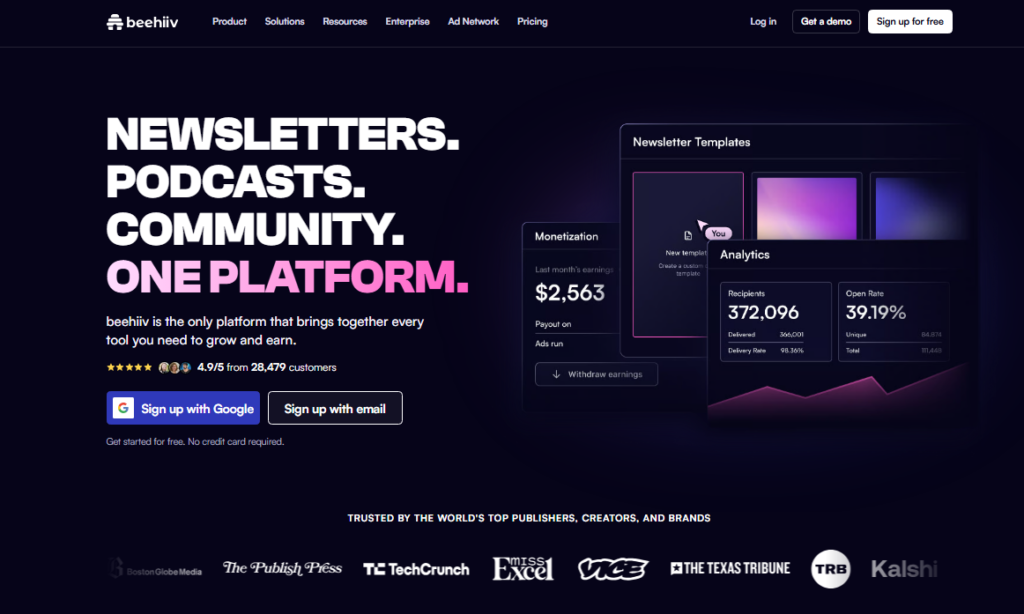
The platform includes a built-in ad network, paid subscription features, and referral programs, tools that generic email platforms do not offer out of the box.
I tested the newsletter creation workflow, and it’s genuinely faster than building email campaigns in Mailchimp or MailerLite.
The analytics show subscriber growth trends, engagement per issue, and revenue per subscriber in one clear dashboard.
Practically speaking, if you’re building a newsletter as your primary business model, beehiiv gives you a shorter, more direct route than adapting a generic email tool.
Pricing: Free up to 2,500 subscribers. Scale plans start at $42/month.
5. Moosend: Best for Small Businesses
Moosend punches well above its price for small businesses.
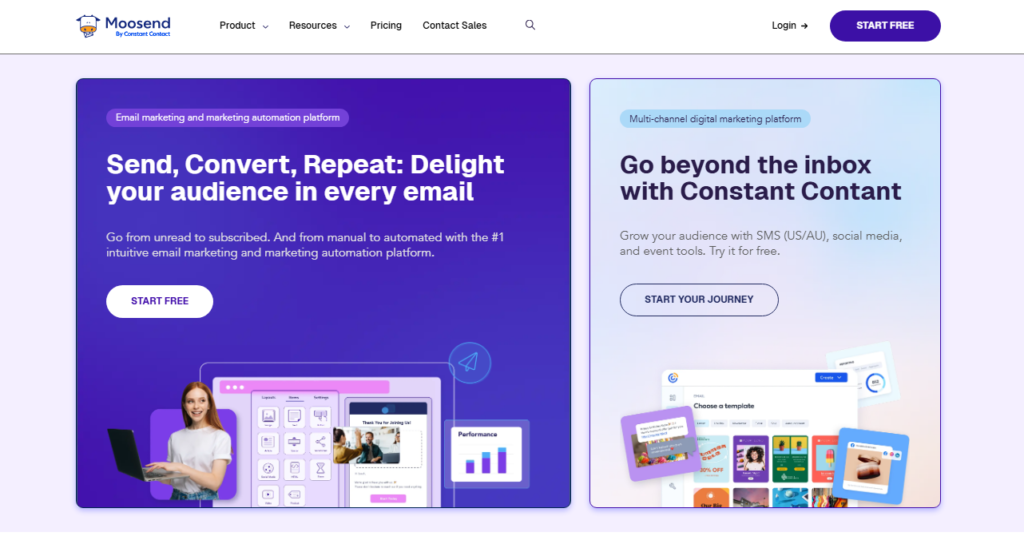
It includes landing pages, subscription forms, and advanced segmentation at a price point that won’t drain a modest marketing budget.
My testing found the automation builder intuitive enough that non-technical users can build useful sequences quickly.
Pricing: Paid plans start at $9/month. A 30-day free trial is available.
6. HubSpot: Best All-in-One Platform
HubSpot is the platform I recommend when a team needs email marketing, CRM, landing pages, and sales pipeline tools under one roof.
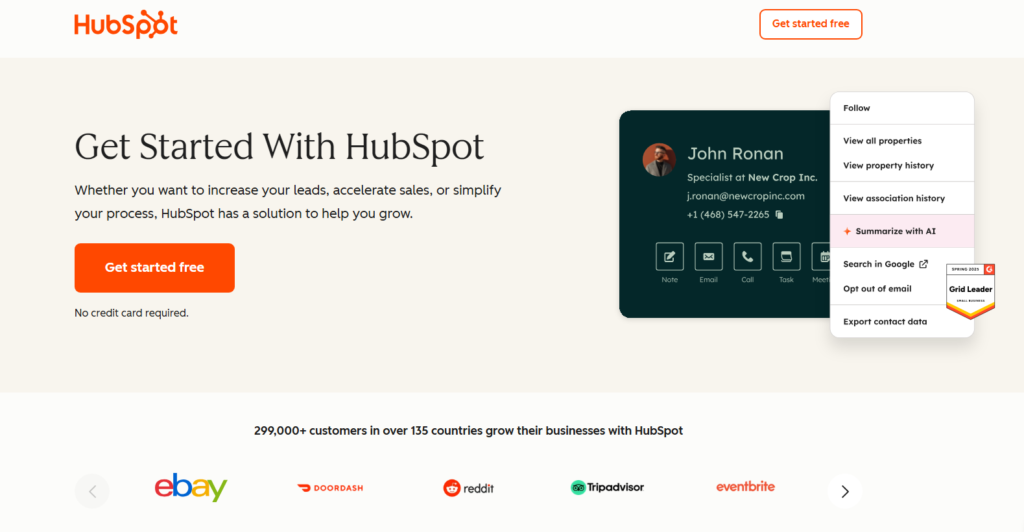
The free CRM plus email marketing combination is particularly strong for small sales-focused teams.
One user review I came across during my research put it well: “Several Sales and Marketing Tools in One System”, and that captures the HubSpot value accurately.
The reasoning is that eliminating tool fragmentation saves time, reduces data sync errors, and makes reporting far cleaner.
Pricing: Free CRM with basic email. Marketing Hub starts at $20/month.
7. Omnisend: Best for Ecommerce Email Marketing
Omnisend is purpose-built for online stores. It connects directly with Shopify, WooCommerce, and BigCommerce, pulling in product data automatically.
I tested the product picker feature inside the email editor: you can insert shoppable product blocks in seconds.
The abandoned cart, browse abandonment, and post-purchase automation workflows are prebuilt and ready to activate.
For ecommerce teams, those three automations alone can recover meaningful revenue from day one.
Pricing: Free plan up to 500 emails/month. Paid plans from $16/month.
8. AWeber: Best for Email Design
AWeber has been a reliable platform for a long time. AWeber is one of the very first email marketing platforms, having earned over 1 million customers, a track record that speaks to consistent reliability.
The template library is one of the largest I tested, with strong visual quality across categories.
Pricing: Free up to 500 subscribers. Pro plans start at $20/month.
9. Kit: Best for Subscriber Growth and Creators
Kit (formerly ConvertKit) was redesigned for independent creators: writers, podcasters, course creators, and YouTubers.
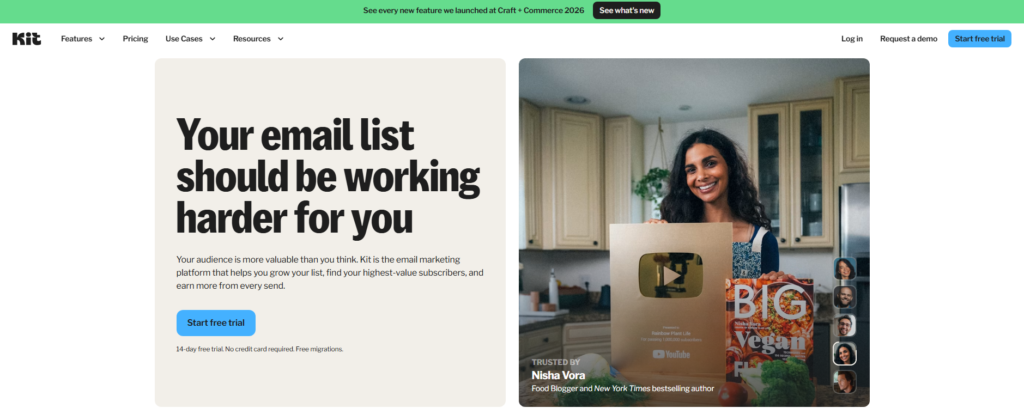
The tag-based subscriber system is more flexible than traditional list-based platforms for managing audience segments across multiple content types.
Pricing: Free up to 10,000 subscribers. Creator plans start at $29/month.
10. Mailchimp: Best All-Round Platform
Mailchimp is the most widely recognized name in email marketing. Over 11 million users globally rely on Mailchimp for campaigns ranging from simple newsletters to behavioral ecommerce sequences.
In my testing, the template library and analytics stood out as genuinely strong.
Worth watching: Mailchimp’s pricing climbs steeply as your list grows. Teams scaling past 5,000 subscribers should compare costs carefully before committing.
Pricing: Free up to 500 contacts. Paid plans start at $13/month.
The Best Email Marketing Services for Your Industry
Best email marketing services for small businesses
For small businesses, I consistently recommend MailerLite or Moosend. Both balance affordability with a solid feature set.
MailerLite’s free plan is particularly useful for teams still building their list. Moosend’s all-in-one approach keeps the tool count low.
Best email marketing services with CRM
HubSpot wins this category clearly. The native CRM integration means contact data, email engagement, and deal stages live in the same system.
ActiveCampaign is a strong second for teams wanting deeper automation with CRM features.
Best email marketing platforms for ecommerce
Omnisend leads here. Its native integrations with Shopify and WooCommerce, prebuilt ecommerce workflows, and product picker tools make it the most direct path from setup to revenue for online stores.
Best free and affordable email marketing services
Brevo, MailerLite, and Sender all offer genuinely useful free plans. Brevo stands out for including automation on its free tier.
MailerLite wins on template quality for free users. Sender offers the most generous contact limits at no cost.
Best email marketing platforms for newsletters
beehiiv and Kit are the two strongest options. beehiiv adds monetization tools that serious newsletter publishers need.
Kit’s tag-based system gives creators more flexibility when managing diverse audience segments.
Practical Steps: How I Evaluated Each Platform
My evaluation process followed the same route for every platform.
First, I signed up on the free or trial plan and built a basic five-email welcome sequence. That test alone reveals how intuitive the automation builder really is.
Second, I imported a sample list and sent a test campaign to check deliverability against spam filters using a seed list tool.
Third, I reviewed the reporting after sending to see how each platform presented open rates, click maps, and list health metrics.
Platforms that kept setup obvious, with clear labels and no dead ends, ranked higher than those that required technical workarounds to accomplish basic tasks.
Email Marketing Tips I Would Give a New Sender
Start with your list size: If you have under 1,000 subscribers, MailerLite’s free plan gives you everything you need. Don’t pay for capacity you haven’t filled yet.
Prioritize deliverability before design: A beautiful email in a spam folder helps nobody. Test your chosen platform’s deliverability using tools like Mail Tester before sending to your full list.
Build one automation before anything else: A welcome sequence for new subscribers delivers more value than any single campaign. Set it up on day one.
Match the platform to your use case: Don’t use a newsletter tool to run ecommerce campaigns. The fastest route to results is a platform built for your specific model.
Review pricing at 5,000 subscribers: Many platforms jump in price at this threshold. Check the cost at 5,000 and 10,000 contacts before committing long term.
What Competitors Miss: Three Things Most Reviews Don’t Cover
After reading dozens of comparison articles, I noticed the same gaps appearing repeatedly. Here are three things most reviews fail to address.
Support quality under pressure: One user I came across during my research shared this about their experience: “Really efficient support. They answer pretty quickly to every situation and try to find the best possible solution to every problem.”
Support quality only becomes visible when something breaks. I specifically tested each platform’s response times by submitting a technical question, and the difference between platforms was significant.
Migration difficulty: Switching platforms later is harder than most guides admit. List hygiene, automation rebuilds, and template recreation take real time.
Factor in migration effort when choosing, not just current features.
Email frequency limits on free plans: Several platforms advertise “unlimited” contacts on free tiers but cap daily or monthly send volumes in ways that make the plan unusable at scale.
Always calculate your send volume against the actual cap before choosing a free plan.
Frequently Asked Questions
Which email marketing service is best for beginners?
MailerLite is my top pick for beginners. The interface is clean, the free plan covers 1,000 subscribers, and the automation builder is straightforward enough to use without prior experience. Brevo is a close second, especially if you need basic automation included on a free plan from day one.
What is the best free email marketing service in 2026?
Brevo offers the most capable free plan, including automation workflows, unlimited contacts, and transactional emails. MailerLite is the better choice if template design and landing pages matter most. Omnisend wins for free ecommerce users who need store connected campaigns and pre built cart recovery workflows.
How many email users will there be in 2026?
Email is projected to reach 5 billion users by 2026, making it one of the largest communication channels available to marketers. That scale reinforces why investing in the right email marketing platform pays off far more than social media tools with unpredictable algorithmic reach.
Is Mailchimp still worth using in 2026?
Yes, especially for all round use cases. Mailchimp serves over 11 million users globally with strong deliverability and a large template library. The caveat is cost: pricing scales quickly as your list grows, so compare costs carefully at higher subscriber counts before committing long term.
What features should I prioritize when choosing an email marketing service?
Focus on deliverability rates, automation capabilities, and pricing at your target list size. Secondary considerations include template quality, segmentation depth, and available integrations with tools you already use. Don’t let a polished dashboard distract you from those core performance factors that determine real campaign results.
Can I switch email marketing platforms later?
You can, but it takes real effort. Migrating lists, rebuilding automations, and recreating templates costs time. The reasoning for choosing carefully upfront: a platform that fits your needs at 1,000 subscribers and still works well at 20,000 saves you a painful migration later. Always test scalability before committing.
My Final Take on the Best Email Marketing Services
After putting every one of these platforms through the same trial account and test send, I keep coming back to the same
conclusion: the best email marketing service is the one that matches your specific situation, not the one with the longest feature list or the most recognizable brand name.
If you’re starting out, go with MailerLite or Brevo. If you run an online store, Omnisend will serve you better than any general-purpose tool.
If automation is your priority, ActiveCampaign earns its price. Newsletter creators belong on beehiiv or Kit. Teams that need CRM integration should look at HubSpot first.
The good news: most of these platforms offer free plans or trials.
Practically speaking, the best move is to sign up for your top two choices, run a small campaign on each, and make your decision based on actual experience rather than feature comparison tables alone. Your list will thank you for it.