Quick Verdict
| Rating: | 4.2/5 |
| Price: | From $39/month (billed annually) |
| Best For: | Aspiring data analysts, scientists, and engineers at beginner to intermediate level |
| Our Take: | DataCamp delivers structured, hands-on data education that most self-taught learners genuinely need. The platform shines for guided learning paths, though advanced practitioners may find the depth limiting. |
If you landed here looking for an honest DataCamp review, you are in the right place.
I spent over three months working through multiple career tracks and courses on DataCamp, and this is my unfiltered take on what works, what falls short, and whether the subscription is worth opening your wallet for in 2026.
Getting Started With DataCamp
Signing up for DataCamp takes about two minutes. You do not need a credit card for the free tier, which I appreciated.
The free account gives you access to the first chapter of every course, enough to get a real feel for the platform before you commit.
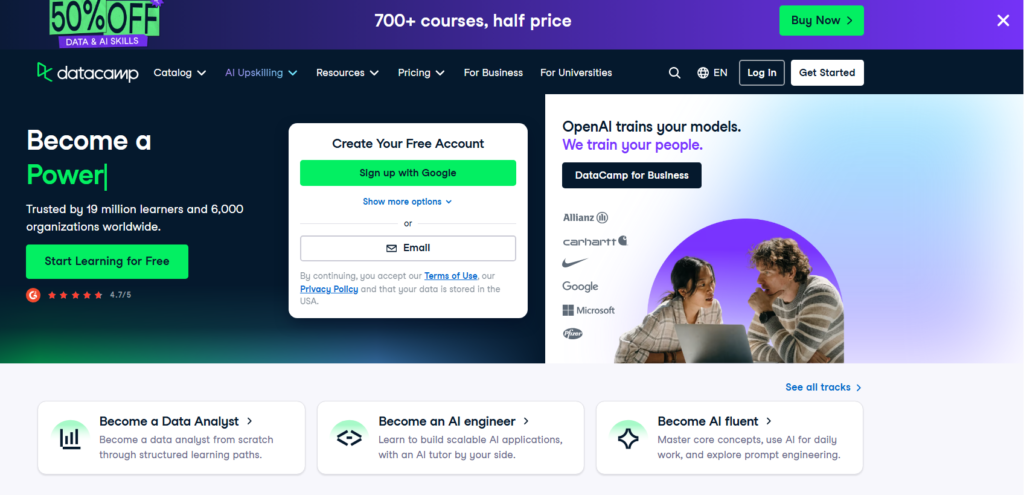
When I first logged in, the dashboard was easy to read. Courses, tracks, projects and certifications each sit in their own labelled section.
You pick a goal, the platform suggests a track, and you work through its lessons in a logical order.
It is genuinely one of the cleaner onboarding experiences I have seen on any learning platform.
The home screen surfaces recommended courses based on your stated goals.
I told DataCamp I wanted to learn Python for data analysis, and within seconds I had a full career track mapped out in front of me.
Career Tracks and Skill Tracks
Tracks are what separate DataCamp from a plain course library.
Instead of picking random classes, you follow a structured path toward a specific job role or skill set.
Career Tracks
Career tracks are designed to take you from zero to job-ready in a specific data role.
DataCamp offers over 15 career tracks covering roles like Data Analyst, Data Scientist, Data Engineer, and Machine Learning Scientist.
I personally worked through the Python Programmer track. It contains 18 courses arranged in a sensible order, starting with absolute basics and building toward practical skills like shell scripting and software engineering principles.
The structure felt thoughtful rather than random.
Eight or more of these career tracks come bundled with a certification exam, which adds real weight to completing them.
Skill Tracks
Skill tracks are shorter and more focused. If you just want to sharpen your SQL window functions or get comfortable with machine learning in R, a skill track gets you there without the full career track commitment.
I found skill tracks useful for filling specific gaps. They are narrow on purpose, covering one skill instead of a whole job role.
They typically run between four and ten courses, which means you can finish one in a few weeks of consistent effort.
DataCamp Courses
Every DataCamp course follows the same pattern. You watch a short video, typically three to five minutes, then immediately practice what you just saw in a browser-based coding environment.
There are no local installs needed, which removes a huge friction point for beginners.
The fill-in-the-blank coding style shapes how much you actually retain, and few DataCamp reviews say so.
The platform writes most of the code and asks you to complete missing pieces. This makes lessons feel approachable, but it also means you are not building full programs from scratch.
Net result: you pick up concepts faster, but you may struggle to write code independently right away.
The video production quality is genuinely high. Instructors are researchers and working professionals, and their explanations are clear without being condescending.
DataCamp DataLab
DataLab is DataCamp’s built-in notebook environment, and it is one of the features that sets the platform apart from competitors.
It behaves like a cloud-based Jupyter notebook, so you can run real analyses without setting up anything locally.
I used DataLab to work through several projects, and it handled Python and SQL without any lag I noticed.
Heavier Spark-based workloads were the exception. They took a few minutes to spin up, which occasionally broke my focus during longer sessions.
DataLab connects directly to course content, so you can move from a lesson straight into an applied project. That tight loop between learning and doing is genuinely useful.
DataCamp Certifications
DataCamp offers three categories of certifications, and this is an area where the platform has invested seriously in 2026.
1. Career Certifications
Career certifications validate your readiness for roles like Data Analyst or Data Scientist. They involve a timed coding exam and a practical case study.
I found the exam format refreshingly real world. You are not just answering multiple choice questions; you are solving actual data problems.
2. Technology Certifications
These certifications focus on specific tools like Python, SQL, Power BI, or Tableau. They are shorter to earn and useful for demonstrating tool-specific competency to an employer.
3. Fundamentals Certifications
Fundamentals certifications cover non-coding skills like data literacy and spreadsheet analysis. These are ideal for business professionals who work with data but do not write code.
The certification exams are proctored and timed, a detail most DataCamp reviews leave out entirely.
You cannot just guess your way through them. I watched a peer fail their first attempt, which tells me the bar is real enough to hold actual value.
User Experience
The interface is clean, minimal, and fast. Navigation tabs for Courses, Tracks, Certifications, Projects, and Competitions are easy to find.
I never felt lost inside the platform, which matters more than most reviewers acknowledge.
The gamification layer deserves a mention. DataCamp awards XP points for completed lessons and tracks learning streaks.
I personally hit a 40 day streak during my testing period, and I am not usually someone who responds to streak mechanics. It works because the daily goal feels achievable rather than overwhelming.
The mobile experience is decent for watching videos but limited for hands-on coding. I would not recommend trying to complete coding exercises on a phone screen.
Pricing in 2026
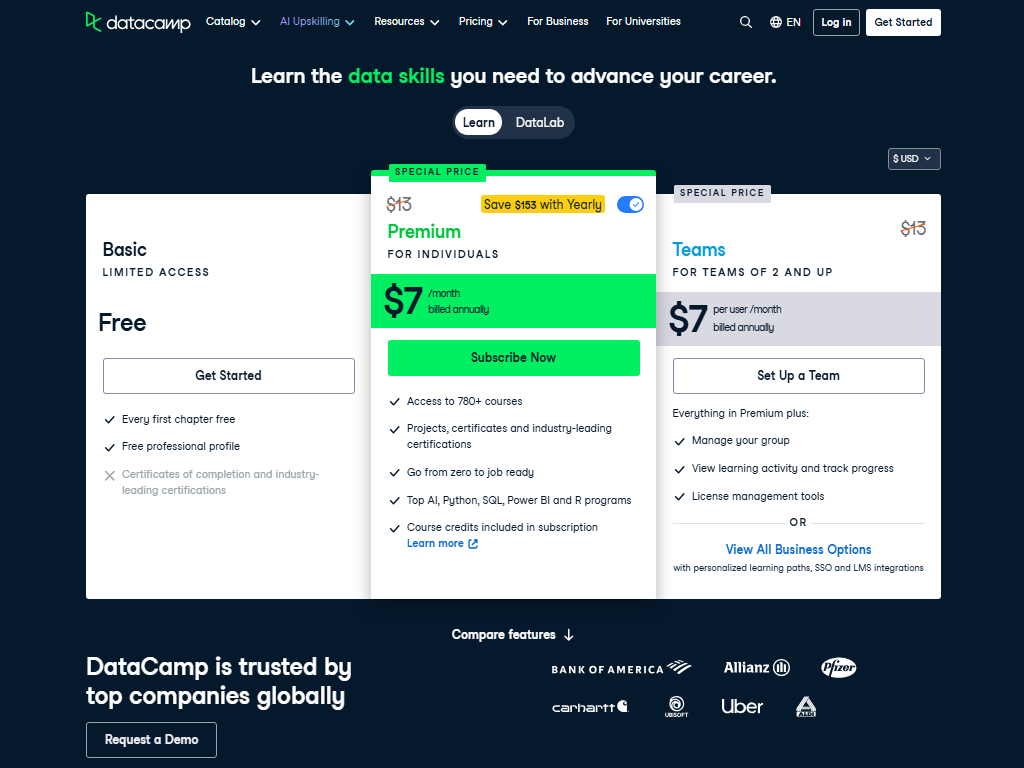
| Plan | Price | What You Get |
|---|---|---|
| Free | $0 | First chapter of every course, limited projects |
| Individual Premium | ~$13/month (billed annually) | Full course library, certifications, DataLab, projects |
| Teams | ~$13/user/month (min 2 users) | Everything in Premium plus team management tools |
To break the math down simply: at $39/month billed annually, you pay roughly $468 per year.
If you complete even one career track and earn a certification that helps you land a data job, the return on that investment is clear.
The catch is that casual learners who log in twice a month will not get their money’s worth.
Support and Community
DataCamp has a community forum where you can post questions about specific exercises. Response times vary.
In my experience, simpler questions got answered within a day, but more complex coding issues sometimes sat unanswered for several days.
There is no live chat or instructor office hours, which is a genuine gap. Paired with that, DataCamp does not offer mentorship or career coaching at the individual subscription level.
If you want a human in your corner, you will need to look elsewhere or upgrade to an enterprise plan.
DataCamp: Things I Like
- Structured learning paths that remove the guess work from what to study next
- Browser based coding environment that requires zero setup time
- High production quality on all video lessons
- Real world data sets used throughout courses and projects
- Gamification that actually encourages daily habits without feeling forced
- Breadth of topics covering Python, R, SQL, Power BI, Tableau, and AI tools
- Certifications with real exam requirements that carry weight with employers
DataCamp: Things I Don’t Like
- Fill-in-the-blank coding limits how much independent problem solving you develop
- Course depth can be shallow, since most videos run under five minutes, which is not enough for complex topics
- No live support or instructor interaction for individual subscribers
- Advanced practitioners will outgrow it quickly, because the platform is built for beginners to intermediates
- Spark and big data courses load slowly in DataLab
What Most DataCamp Reviews Won’t Tell You
Most review sites praise DataCamp’s breadth and leave it there. What they skip is this: the platform is designed to teach you the shape of a skill, not the full muscle behind it.
You will learn what a machine learning pipeline looks like, but building one from scratch in a real job environment requires additional practice outside the platform.
The second gap is the handoff from course to project.
The projects section asks you to apply skills in a more open-ended environment, and that jump in difficulty is steeper than the platform prepares you for. It caught me off guard more than once.
Third, the annual pricing model rewards committed learners and penalizes casual ones.
If you plan to sprint through a full career track over six focused months, the value is genuinely excellent. If you are browsing occasionally, the free tier is probably enough.
Who Should Use DataCamp
DataCamp is a strong fit if you are a career changer moving into data from another field, a student wanting structured data science education alongside a degree, or a business professional who needs to get comfortable with data tools fast.
You should skip it if you are already working as a data professional with two or more years of experience, if you need deep specialization in a single advanced topic, or if you prefer live instruction with real-time feedback.
Frequently Asked Questions About DataCamp
Is DataCamp worth it for complete beginners?
Yes, DataCamp is genuinely beginner friendly. The browser based coding environment removes technical setup barriers, and career tracks guide you step by step without requiring you to figure out what to study. I found the beginner content clear, well paced, and easy to follow even without prior programming experience.
Does DataCamp offer a free trial?
DataCamp has a permanent free tier that gives you the first chapter of every single course at no cost. No credit card is required to sign up. This is enough to properly evaluate whether the teaching style and platform feel right before committing to a paid subscription.
Are DataCamp certifications recognized by employers?
DataCamp certifications are recognized by a growing number of employers, particularly in tech and analytics. They carry more weight than simple course completion certificates, and that is because the exams are timed, proctored, and require hands-on problem solving rather than multiple choice answers.
How long does it take to complete a DataCamp career track?
Most career tracks take between 60 and 100 hours of total learning time. At one hour per day, you could complete a full track in roughly three to four months. Motivated learners who put in more daily time can finish faster. Pace is entirely self directed, which suits working adults well.
How does DataCamp compare to Coursera or Udemy?
DataCamp is more focused than both. Coursera covers hundreds of subjects; Udemy has everything. DataCamp covers only data and AI topics, which means greater depth in that lane. The interactive coding environment also beats passive video only platforms for hands-on skill building in data science.
Can I cancel my DataCamp subscription anytime?
Yes, you can cancel your DataCamp subscription at any time through your account settings. The annual plan does not auto renew without notice. DataCamp also offers a refund within a defined window after purchase, so check the current refund policy on their website before you buy.
Final Verdict: Is DataCamp Worth It in 2026?
After working through those career tracks, the DataLab projects and the certification format, my DataCamp review lands here: this is one of the best structured learning platforms available for anyone entering the data field in 2026.
The career tracks are well built, the coding environment is smooth, and the certifications hold real value.
The platform is not perfect. Shallow video depth and fill-in-the-blank coding limit how independently strong you become without supplementing your practice elsewhere.
Net result: treat DataCamp as the foundation of your data education, not the entire building.
If you are serious about breaking into a data career, the annual subscription pays for itself quickly once you land even a modest salary increase.
If you are dabbling, start with the free tier and see how far it takes you.