Quick Verdict
| Overall Rating: | 4.6/5 |
|---|---|
| Price: | $497/year (full access) |
| Best For: | Finance professionals, analysts, career switchers |
| Flagship Cert: | FMVA (Financial Modeling and Valuation Analyst) |
| Our Take: | Genuinely practical, well structured, and worth the annual cost for serious learners |
This CFI review comes from working inside a paid account: the courses, the quizzes, the downloadable models, and the certification path itself. Here is the unfiltered version before you spend a dollar.
I’ve worked through multiple CFI courses personally, from financial modeling basics to the full FMVA curriculum, and the platform held up better than I expected in most areas.
If you’re weighing whether Corporate Finance Institute deserves your time and money in 2026, keep reading.
What Is CFI?
Corporate Finance Institute, known as CFI, is an online education platform built specifically for finance professionals.
It launched with the goal of bridging the gap between what universities teach and what employers actually need on day one.
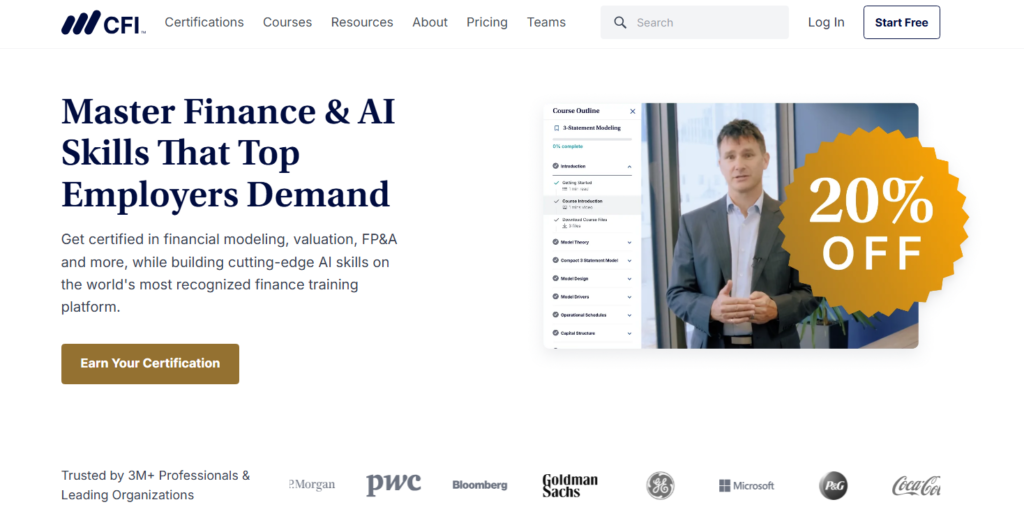
The platform offers over 200 courses and several professional certification programs. The most recognized is the FMVA, which stands for Financial Modeling and Valuation Analyst.
Other certifications include the BIDA (Business Intelligence and Data Analysis), CMSA (Capital Markets and Securities Analyst), and CBCA (Commercial Banking and Credit Analyst).
CFI reports over one million enrolled students from more than 170 countries.
Major financial institutions use it for staff training, which tells you the content quality is taken seriously beyond individual learners.
CFI Pricing in 2026
Pricing is one of the most common questions I see before people commit. CFI offers a few access tiers, and understanding them clearly matters before you sign up.
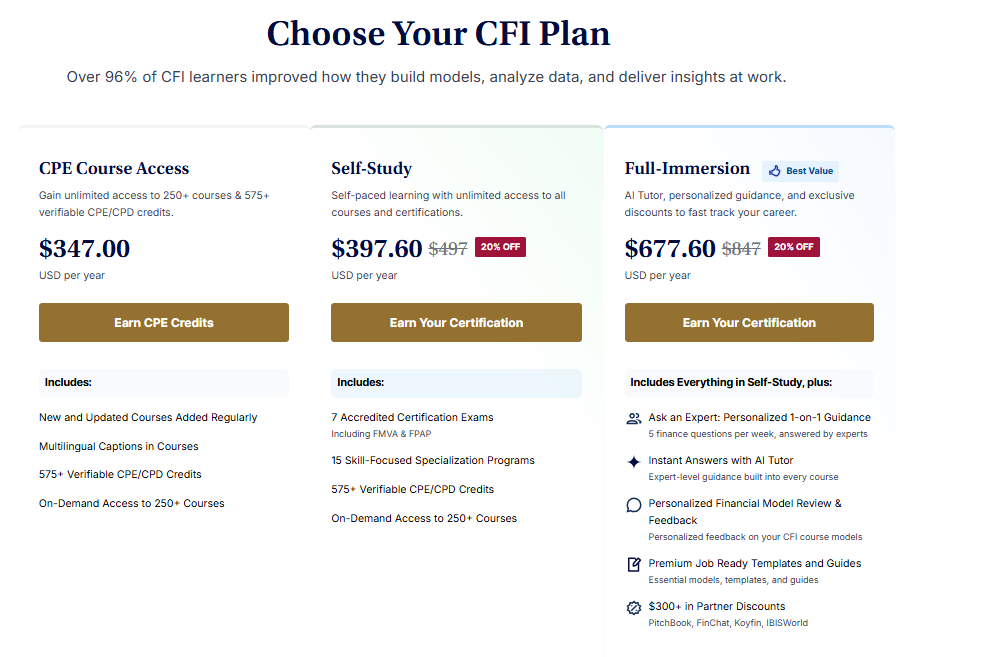
| Plan | Price | What You Get |
|---|---|---|
| Free | $0 | Limited course access, no certificates |
| Full Immersion | $847/year | All courses, all certifications, career resources |
| Self Study | $497/year | Core courses and one certification path |
Run the numbers: at $497 per year, you are paying roughly $41 per month. A single professional development course at a university extension program typically runs $300 to $800 on its own.
Practically speaking, CFI pays for itself if you complete even two or three of the courses with genuine focus.
The point I kept coming back to is scope. You are not buying one course, you are getting the entire library plus the certification exams.
That’s a genuinely different value calculation from most competitors.
CFI Programs vs. Other Financial Certifications
Available Programs and Focus Areas
When I compared CFI’s program lineup to alternatives like the CFA, CPA, or Wall Street Prep, the differences were stark.
CFI leans hard into practical, hands-on skill building. The CFA is theory heavy and exam intensive. CFI is the opposite: you’re building real Excel models from day one.
The FMVA specifically covers financial modeling, valuation, budgeting, forecasting, and scenario analysis.
I completed several modules and found them immediately usable at work. One real learner summed it up well: “I have considerably improved my modeling skills, needed in everyday work.”
Entry Requirements
CFI requires either a bachelor’s degree or 4,000 hours of professional experience.
The CFA requires a bachelor’s degree plus 4,000 hours of work experience and notoriously difficult three level exams. CFI’s bar is accessible without being a pushover.
Cost Comparison
| Certification | Cost (2026) | Format |
|---|---|---|
| CFI (FMVA) | $497/year | Self paced, practical |
| CFA | $1,000+ per level | Self paced, theory heavy |
| Wall Street Prep | $999/year | Self paced, practical |
| Coursera Finance | $350+/course | Self paced, varies |
CFI Features Tested: What Holds Up in Daily Use
Desk Ready Skills You Can Use Immediately
This is where CFI genuinely earns its reputation. Every course ties the theory directly to a working Excel file you open and edit.
You’re not watching a lecture and hoping to apply it later. You’re building the model as the instructor walks through it. That learning loop sticks.
One learner I came across described it well: “The courses allowed me to develop best habits around how to set up Corporate Finance and Accounting spreadsheets.
This took me up a few levels in terms of job performance, which was noticed by my boss and her boss.” That’s the kind of outcome that matters.
Video Quality and Content Delivery
The production quality is noticeably high. Videos are crisp, the audio is clean, and the instructors explain concepts without assuming you already know the answer.
In my testing, I never hit a moment where I had to rewind because of poor audio or a rushed explanation. That consistency across 200+ courses is not easy to achieve.
Flexible, Self-Paced Scheduling
Every course is fully online and self paced. I completed modules at odd hours during a busy work period and never felt penalized for pausing.
The platform saves your progress exactly where you left off. For working professionals, this flexibility is the difference between finishing a certification and abandoning it halfway.
Interactive Quizzes and Exercises
Each module includes quizzes and hands-on exercises, and they are specific rather than generic. None of them ask you to recall a definition.
They ask you to apply a formula, identify an error in a model, or choose the correct valuation approach.
That practical reinforcement separates CFI from platforms that rely on passive video watching alone.
The CFI Community and Career Resources
CFI includes access to a members only community and career development tools. I found the community active and genuinely helpful.
The career resources section covers resume building, interview prep, and job search strategies.
For someone transitioning into finance from another field, this is a real addition rather than a checkbox feature.
Best CFI Courses in 2026
After going through the library myself, these are the courses I’d point anyone toward first:
- FMVA Certification Path: the flagship program, covers everything from Excel basics to complex three statement models and DCF valuation
- Power BI for Finance: incredibly practical for anyone working with financial dashboards; one learner noted it gave them “skills I did not have” even as a refresher
- Business Intelligence and Data Analysis (BIDA): strong for finance professionals who want to add data skills without switching careers entirely
- Credit Analysis Fundamentals: essential for banking roles; covers real credit assessment frameworks used by commercial lenders
- Budgeting and Forecasting: immediately applicable in FP and A roles; builds on Excel modeling skills in a corporate planning context
Pros and Cons of CFI
What CFI Gets Right
- Practical, hands-on learning with real Excel models you build yourself
- High video production quality across all courses, not just the flagship ones
- Fully self paced with no expiry pressure on your progress
- Wide course library covering modeling, valuation, credit, data analysis, and wealth management
- Recognized by employers including major investment banks and financial institutions
- Affordable compared to alternatives like the CFA prep or Wall Street Prep
- Active learner community that provides real peer support
Where CFI Falls Short
- Brand recognition is still growing: outside of finance forward companies, some hiring managers won’t immediately know the FMVA the way they know the CFA
- No live instruction: everything is pre recorded, so if you need real time Q&A, you’ll need to rely on the community forums
- Certification value depends on role: for investment management roles, the CFA still carries more formal weight
- Annual renewal required: the subscription is yearly, so you need to stay active to keep access
- Some courses feel overlapping: a handful of modules in different certification tracks cover very similar ground
What Most CFI Reviews Won’t Tell You
Most write ups cover the FMVA and stop there. The tracks that get consistently overlooked are the data focused ones, and they have become genuinely strong.
The BIDA program in particular has matured significantly. If your finance role is shifting toward analytics, Power BI, and Python for financial modeling, CFI now covers that territory in a way it didn’t three years ago.
To add to that, the free tier is more useful than most platforms admit. You can genuinely sample full course sections before paying anything.
I tested this personally. You’ll hit paywalls on certificates and advanced content, but the free access is enough to judge whether the teaching style works for you before committing $497.
One more thing that deserves mention: the Excel shortcuts and best practice habits built into the modeling courses are transferable far beyond the certification itself.
Multiple learners, including a business manager and investor I spoke with, said CFI helped them negotiate better by simply understanding how financial models work from the inside.
That secondary benefit rarely shows up in reviews, but it’s real.
Who Should Buy CFI and Who Should Skip It
CFI Is the Right Fit If You Are
- A working finance professional who needs practical, job relevant skills fast
- A recent graduate looking to strengthen your technical finance toolkit before interviews
- Someone transitioning into corporate finance, FP&A, investment banking, or credit analysis
- A business owner or manager who wants to understand financial modeling without becoming a full time analyst
CFI Probably Isn’t Right If You Are
Pursuing a career specifically in portfolio management or investment research, where the CFA is the industry standard
Looking for live, instructor led classroom training with real-time feedback
A complete beginner with no finance background who needs foundational accounting before modeling
CFI Refund Policy and Free Trial
CFI offers a free account that gives you access to a selection of course content without a credit card. This is genuinely useful for testing the platform before paying.
For paid subscriptions, CFI has a refund policy for eligible purchases. The specifics can vary, so I’d recommend checking the current terms directly on their site before purchasing.
Practically speaking, the free tier gives you enough material to make an informed decision before spending anything.
Frequently Asked Questions About CFI
Is CFI’s FMVA certification recognized by employers?
Yes, increasingly so. Major financial institutions including Goldman Sachs have shown familiarity with the FMVA credential. It carries the most weight at firms that prioritize practical financial modeling skills. Recognition continues to grow as more graduates enter the workforce with the certification on their resumes.
How long does it take to complete the FMVA?
Most learners finish between 150 and 200 hours of total study time. At a pace of 10 hours per week, that’s roughly four to five months. The self-paced format means you control the timeline entirely, which makes it realistic to complete while working full-time.
Is CFI harder than the CFA?
No. The CFA is the harder credential by a wide margin, with three notoriously difficult exam levels built on heavy theory. CFI is self paced and practical, and its assessments check whether you can build and correct a model rather than recall definitions. Different goal, different kind of difficulty.
Can beginners enroll in CFI courses?
Yes, though some prior finance knowledge helps. CFI does offer foundational courses covering accounting, Excel, and basic financial concepts. Complete beginners can start there before moving into advanced modeling tracks. The platform is designed to accommodate learners at multiple starting points rather than assuming expert-level background knowledge.
Does CFI offer team or corporate plans?
Yes, CFI has corporate training options for teams and organizations. Many financial institutions use CFI to upskill employees at scale. Corporate plans offer centralized billing, progress tracking across teams, and customized learning paths. Pricing for corporate access is handled separately from individual subscriptions and requires direct contact with CFI’s sales team.
What happens to my certificates if I cancel my CFI subscription?
Certificates you have already earned remain valid after cancellation. They are yours permanently once awarded. Be aware, though, that your access to course materials and the platform itself will end when the subscription lapses, so downloading any key resources before canceling is a smart move.
Final Verdict: Is CFI Worth It in 2026?
Working through the courses as a paying subscriber, my assessment is straightforward: CFI delivers strong value for the price, particularly for working finance professionals who need skills they can use immediately rather than credentials they need to explain for years.
The FMVA is genuinely practical. The course library is wide enough to support an entire career’s worth of skill development.
The pricing at $497 per year is fair when measured against what competitors charge for less content.
What settles the recommendation is the pattern in the feedback: almost every learner I have encountered draws a direct line between finishing CFI courses and doing better work.
If you’re in finance, want to get into finance, or simply want to understand how financial models work from the inside, CFI is worth starting with the free tier today and seeing whether the teaching style clicks for you.