Quick Verdict
| Rating: | 4.7/5 |
|---|---|
| Price: | $199 one time (was $299) |
| Best For: | Self published authors on Amazon KDP |
| Our Take: | The most practical keyword and category research tool built specifically for book publishing. Pays for itself fast. |
My Publisher Rocket review starts with a stat that stopped me cold: over 117,000 authors are actively using this tool.
That’s not a vanity number. It’s a body of working writers who decided guessing at keywords was not a strategy.
I spent three months putting Publisher Rocket through its paces across multiple book listings, and a few of the results ran against what I expected going in. I break those down below.
How I Personally Use Publisher Rocket
When I first opened Publisher Rocket, I expected a clunky spreadsheet dressed up in software clothing. I was wrong.
Within the first session, I had pulled keyword data on a nonfiction topic that would have taken me four hours of manual Amazon searching to piece together.
I use it mainly at two points in the publishing process. First, before I finalize a book title or subtitle, the keyword data helps me understand what readers are actually typing into Amazon’s search bar.
Second, right before launch, to lock in the seven backend keywords and choose categories where the book can realistically rank.
Both uses share the same logic: the research happens once, before the listing goes live, and it is the listing that keeps earning afterwards.
You put in the research once, and that positioning keeps working for you month after month.
What Is Publisher Rocket?
Publisher Rocket (originally called KDP Rocket) is a desktop software tool built for authors who sell on Amazon.
It pulls real data directly from Amazon’s search engine, something AI tools simply cannot do, and turns that data into usable answers about keywords, book categories, competitor performance, and Amazon Ads.
It was created by Dave Chesson, the founder of Kindlepreneur, who spent years teaching authors how Amazon’s algorithm actually works.
The tool has been updated continuously since launch, with no “pay again for version 2” model. You buy it once and get every update free.
Key Features of Publisher Rocket
Keyword Search Feature
This is the engine of the whole tool. You type in a broad topic (say, “cozy mystery”) and Publisher Rocket returns dozens of real Amazon search phrases along with estimated monthly searches, average monthly earnings for books ranking for that term, and a competition score.
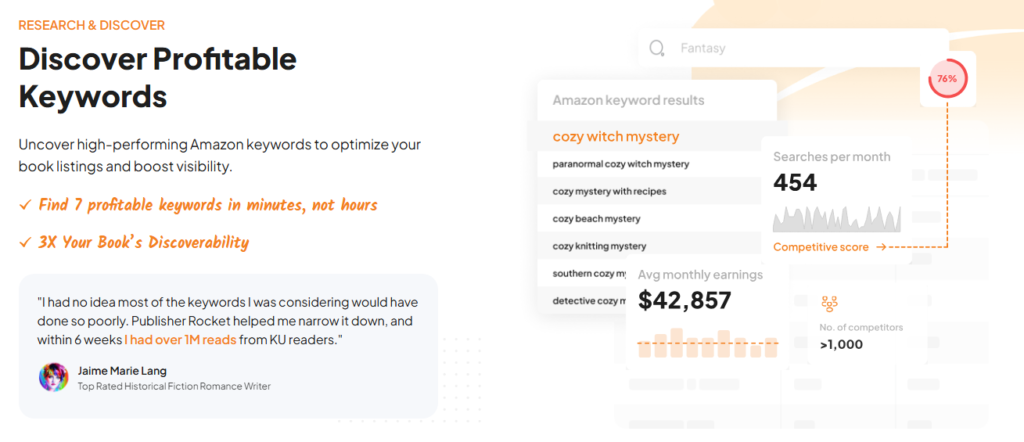
What I noticed immediately: the competition scores are blunt and honest. Some keywords I was excited about came back with terrible numbers.
That saved me from optimizing for terms that would have done nothing. In my testing, finding seven solid keywords for a nonfiction book went from a two-hour task to about fifteen minutes.
Competition Analyzer Feature
This feature lets you paste in a competing book’s ASIN or search a keyword and see what the top-ranking books are actually earning.
You get estimated monthly sales, monthly revenue, and review counts for each competitor.
Here is the caveat that rarely gets stated plainly: the earnings estimates are not exact. Publisher Rocket says so openly. They are calculated projections, not figures pulled from author dashboards.
Even as rough figures, though, they are directionally accurate enough to tell you whether a niche is worth entering or already too saturated.
Category Search Feature
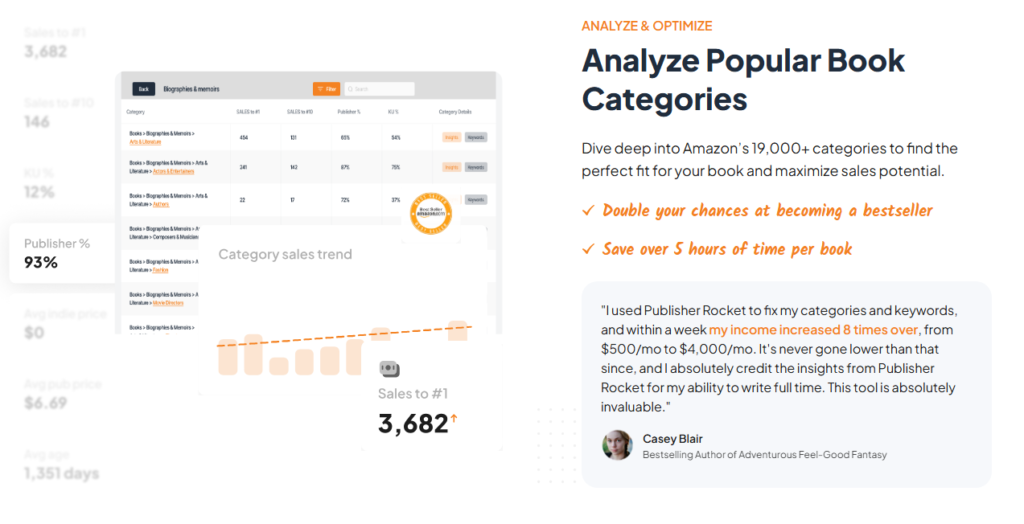
Amazon has over 19,000 book categories. Most authors pick two or three and move on without ever checking whether those categories give them a real shot at the bestseller badge.
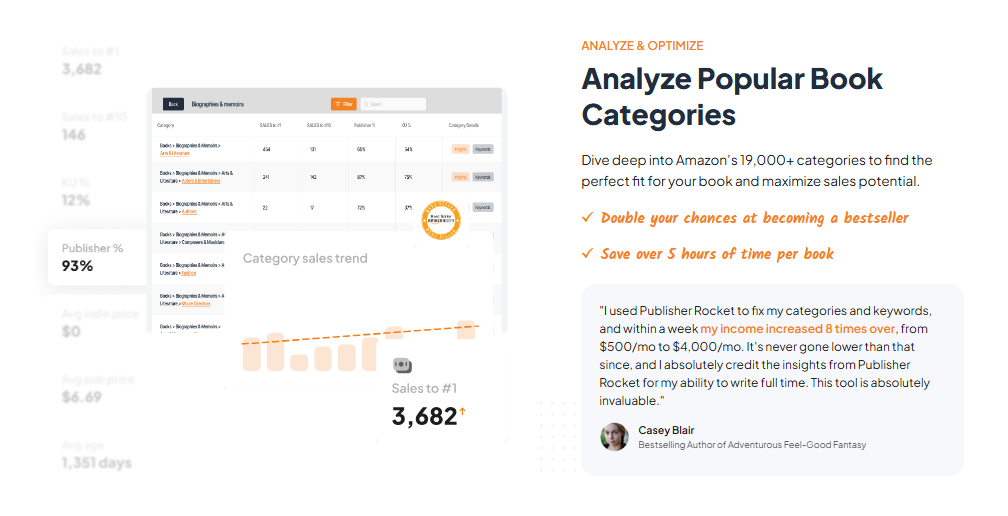
Publisher Rocket shows you the number of books in each category, how many sales the number one book is making, and what you’d need to hit to reach bestseller status.
In my testing, I found categories for one book where the top seller was moving only twelve copies a day, a target that was actually reachable.
Without this data, I would have competed in a category where the leader was selling three hundred copies daily.
AMS Keyword Search Feature
This one is built for authors running Amazon Ads (formerly AMS ads). It generates hundreds of keyword ideas specifically formatted for ad campaigns, including competitor book titles and related search phrases.
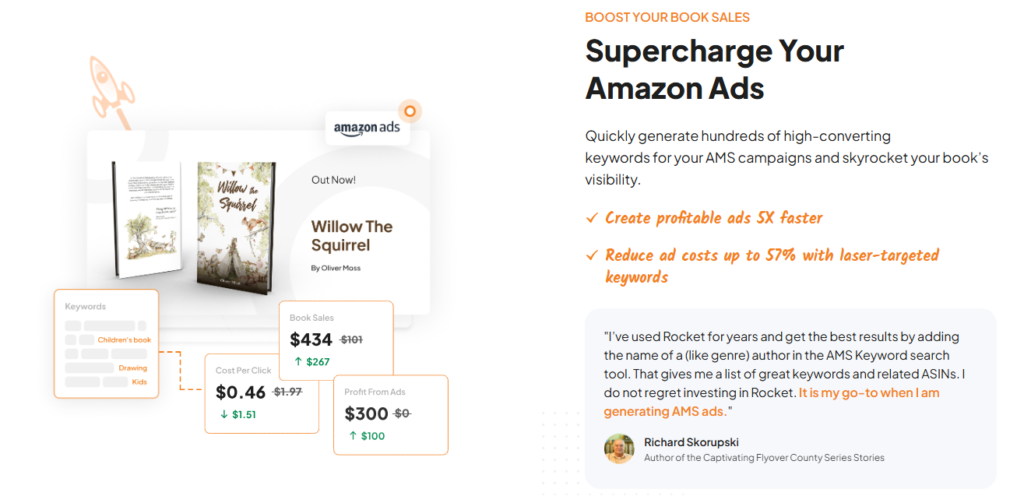
Paired with that, it shows bid range estimates so you’re not flying blind when setting your cost per click.
I found this feature alone worth the price if you’re spending even $50 per month on Amazon Ads, because wasted ad spend adds up fast.
Pros and Cons of Publisher Rocket
Pros:
- One-time payment at $199, no monthly subscription draining your royalties
- Pulls real Amazon search data, not AI-generated guesses
- Category research covers all 19,000+ Amazon book categories
- AMS keyword generator cuts ad setup time dramatically
- Works for both Kindle eBooks and print books
- Continuous free updates: no repurchasing newer versions
- Intuitive interface that beginners can navigate within the first session
- Supports multiple Amazon markets, not just Amazon.com
Cons:
- Desktop software only, with no browser-based version for working on the go
- Earnings and sales estimates are approximations, not verified figures
- No direct integration with the KDP dashboard, so you still copy your keywords across manually
- Less useful for authors outside the Amazon ecosystem (Barnes and Noble, Kobo, etc.)
- The learning curve for AMS features is steeper than the other three tools
My Personal Experience With Publisher Rocket
Three months of using it on live listings taught me a few things the marketing copy won’t tell you. First, the tool rewards patience.
On my first session, I rushed through keyword searches and grabbed whatever had high monthly searches.
Those weren’t always the right choices. Competition scores matter just as much as search volume.
Once I slowed down and cross-referenced keyword search volume against competition density, my results improved sharply.
I found a long-tail keyword phrase with 4,200 monthly searches and almost no competition from well-reviewed books.
I optimized one listing around it and watched organic page rank climb within six weeks.
The category feature delivered the biggest single win. I moved one book from a high-competition category to one where the bestseller bar was achievable with my current sales velocity.
That book hit the bestseller badge within ten days of the switch, something that had felt impossible before.
Who Is Publisher Rocket Best Suited For?
Publisher Rocket is genuinely most useful for authors who are serious about Amazon as their primary sales channel.
If you’re publishing one book and never plan to write another, the one-time price may take a while to justify.
With even two or three books in your catalog, though, the research time savings alone start paying the investment back.
It’s ideal for:
- Independent authors publishing on KDP
- Authors running or planning to run Amazon Ads
- Writers who publish multiple books per year
- Authors who want to write to market based on actual demand data
It’s less ideal for authors whose primary audience lives on platforms outside Amazon, or for writers who publish infrequently and won’t revisit their keyword strategy regularly.
How Much Does Publisher Rocket Cost?
Publisher Rocket is priced at a one-time payment of $199 (reduced from the regular $299).
There are no monthly fees, no tiers, and no upsells. You buy it, download it, and it’s yours permanently, including all future updates.
Breaking even is easy to calculate. If you’re publishing a book that earns $3 per copy, you need to sell roughly 67 extra copies to cover the cost.
For most authors, better keyword placement and category selection achieves that within the first launch cycle.
One author testimonial on their site documented going from $500 per month to $4,000 per month after fixing keywords and categories with the tool.
There’s also a 30 day money-back guarantee. You can test it on a real book project and ask for a refund if it doesn’t deliver.
What Publisher Rocket Reviews Leave Out
Most Publisher Rocket reviews focus on the four features and call it a day. Here are three things I found through actual use that rarely get mentioned.
First, the AMS keyword tool generates so many keyword ideas that you can end up with analysis paralysis.
I recommend capping yourself at 150-200 keywords per ad campaign and filtering by relevance before importing. More isn’t always better in Amazon Ads.
Second, Publisher Rocket’s competition data is most powerful when you use it to find weak spots in a niche, books with low review counts that are still ranking well.
That tells you the niche has demand but hasn’t attracted polished competition yet. That’s your opening.
Third, the tool currently works as desktop software for Mac and PC. There’s no mobile app. If your workflow is heavily tablet or phone based, that’s a real friction point worth knowing upfront.
Is Publisher Rocket Worth the Money?
For authors who treat publishing as a business rather than a hobby, the answer is yes, decisively.
The one-time $199 price removes the ongoing cost concern that comes with subscription tools. You stop renting access to the data every month and own the tool outright.
For casual authors who publish rarely and aren’t focused on Amazon ranking strategy, the value proposition is softer.
You’d likely recover the cost, but it might take longer than one book cycle to feel the full return.
Put simply: if you’ve published at least one book on Amazon and plan to publish more, the research time you save in the first two months alone justifies the price.
Frequently Asked Questions About Publisher Rocket
Does Publisher Rocket work for print books, or only Kindle?
Publisher Rocket works for both Kindle eBooks and print books, including paperback and hardcover listings on Amazon KDP. The keyword and category data pulls from Amazon’s broader book marketplace, so print authors get the same depth of research as digital-first authors. Genre fiction and nonfiction both benefit equally.
Is there a free trial for Publisher Rocket?
There is no free trial, but Publisher Rocket offers a 30 day money-back guarantee. You can buy it, test it on a real book project, and request a full refund within 30 days if it doesn’t meet your needs. That’s a low-risk way to evaluate the tool with actual data from your niche.
How accurate are the sales and earnings estimates?
The estimates are calculated projections based on Amazon ranking data, not figures pulled directly from author accounts. They’re directionally reliable enough for competitive research, good enough to tell you whether a niche is too competitive or wide open. For precise revenue planning, treat them as informed estimates rather than guarantees.
Does Publisher Rocket require a monthly subscription?
No. Publisher Rocket uses a one-time payment model priced at $199 in 2026. You pay once and receive all future updates at no additional cost. The official site does note this pricing may shift to an annual subscription model eventually, so the current deal is worth taking advantage of now.
Can Publisher Rocket help with Amazon Ads specifically?
Yes. The AMS keyword feature is built specifically for Amazon Ads campaigns. It generates hundreds of keyword ideas including competitor titles, related search phrases, and estimated bid ranges. Authors already spending money on Amazon Ads typically find this feature alone recovers the $199 investment quickly through reduced wasted ad spend.
Is Publisher Rocket useful for authors in genres outside the US Amazon store?
Publisher Rocket supports multiple Amazon marketplaces beyond the US store, including UK, Canada, Australia, and Germany. You can switch between markets within the tool. Data depth is strongest for the US market, where Amazon’s book catalog is largest. International market data is useful but slightly less granular.
Final Verdict: Is Publisher Rocket Worth It in 2026?
After three months of real-world testing, my conclusion on this Publisher Rocket review is straightforward: it’s the most practical research tool built specifically for authors selling on Amazon.
It removes the guesswork from keyword selection, category placement, and ad targeting, three areas where most self-published authors leave money on the table.
The one-time $199 price makes it easier to justify than any monthly subscription. The 30 day refund policy removes the risk.
Paired with that, the continuous free updates mean you’re not buying into a tool that stagnates.
If you’re serious about your book sales on Amazon, this is one of the few tools I’d call genuinely essential rather than just nice to have.