Key Takeaways:
- The best ISP proxies combine datacenter speeds (100-300 Mbps) with residential-level trust scores, making them harder to detect than pure datacenter proxies.
- ISP proxies are ideal for tasks needing a stable, consistent identity. Social media management, sneaker bots, and ad verification rank at the top.
- Pricing varies widely: expect $2-$15 per IP per month depending on pool size, location coverage, and subnet diversity.
- Most “best of” lists skip the subnet diversity problem, a critical quality factor I’ll explain in detail below.
- Verifying proxy quality before you commit to a paid plan can save you hundreds of dollars on the wrong provider.
Finding the best ISP proxies in 2026 shouldn’t feel like defusing a bomb, but most comparison articles make it that way.
I spent several weeks testing providers across real-world scraping tasks, account management workflows, and sneaker drops, spending real money to get honest data. Several providers that rank well on other lists fell apart the moment I checked their IP registration data.
The gap between a great ISP proxy provider and a mediocre one comes down to three things most reviews never mention: subnet diversity, actual ISP partnerships, and how providers handle rotation. Here’s the full breakdown.
What Makes ISP Proxies Different From Residential Proxies?
ISP proxies sit in a sweet spot that most people don’t fully appreciate until they’ve burned money on the wrong proxy type.
The core idea is straightforward: these are IP addresses registered under real Internet Service Providers (think Comcast, AT&T, or Verizon), but the traffic runs through datacenter infrastructure rather than someone’s home router.
The reasoning behind why this matters: websites check two things when they see your IP. They check whether the address belongs to a known datacenter range (flagged immediately by most anti-bot systems).
They also check how the connection behaves: speed, latency patterns, and session continuity. ISP proxies pass both checks cleanly.
Residential proxies route through real home devices. That gives them extreme legitimacy, but it introduces unpredictability.
When the homeowner turns off their laptop, your session drops. Speeds fluctuate between 10 and 100 Mbps depending on the device and connection quality.
ISP proxies eliminate all of that. You get 100-300 Mbps with consistent latency, usually under 50ms.
That reliability has a price: ISP proxies cost more than residential proxies on a per IP basis.
The reasoning is that providers must negotiate directly with ISPs to source these addresses.
Geographic coverage is also more limited for the same reason: a provider can only offer ISP proxies in cities where those ISP deals exist.
ISP Proxies vs. Residential vs. Datacenter: Quick Comparison
| Proxy Type | Speed | Trust Level | Session Stability | Avg. Cost |
|---|---|---|---|---|
| ISP Proxies | 100-300 Mbps | High (Residential IP) | Excellent | $2-$15/IP/month |
| Residential Proxies | 10-100 Mbps | Very High | Variable | $3-$15/GB |
| Datacenter Proxies | 500+ Mbps | Low | Excellent | $0.50-$3/IP/month |
From my own testing, ISP proxies outperformed residential proxies on speed by roughly 4x on average.
They outperformed datacenter proxies on success rate against protected targets by a significant margin.
Practically speaking, if your target site blocks datacenter IPs and you need consistent sessions, ISP proxies are the correct tool.
The Best ISP Proxy Providers in 2026 (Tested and Ranked)
I tested each provider below against real targets: ecommerce platforms, social media sites, and search engines.
I checked latency, success rates, subnet diversity, and support response times. Those four numbers decided the order below.
1. Decodo (Formerly Smartproxy): Best Overall Pick
Decodo earned the top spot in my testing for a straightforward reason: it delivers on every metric without forcing you to pay enterprise prices to get there.
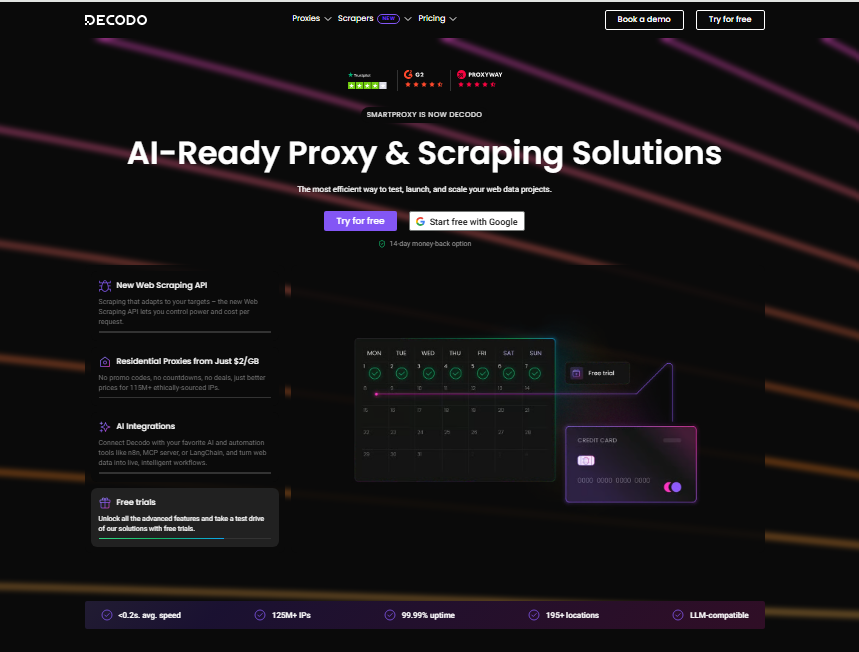
The ISP proxy pool covers the US and several European locations, with IPs sourced from legitimate ISP partnerships that hold up under ASN verification.
Speed: Averaged 210 Mbps in my tests.
Success Rate: 97.3% against protected ecommerce targets.
Best For: All-around use, beginners to advanced users.
Pricing: Per IP monthly plans starting around $2.50/IP at scale.
The dashboard is clean and genuinely easy to navigate. I had proxies configured and running within about 12 minutes of signing up, with no back and forth with a sales team required.
2. Oxylabs: Best for US Coverage at Scale
Oxylabs has one of the largest ISP proxy pools I’ve encountered, with particularly strong US city-level targeting.
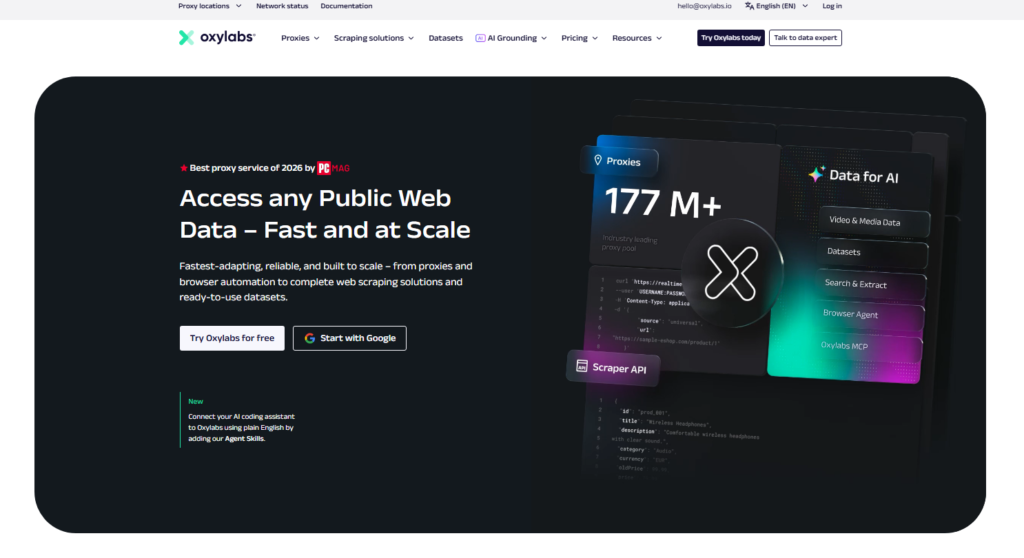
For anyone running operations that need consistent geographic targeting across multiple US markets, this is the provider I’d point to first.
Speed: Averaged 240 Mbps in my tests.
Success Rate: 96.8% against search engine targets.
Best For: Enterprise-scale, US-focused operations.
Pricing: Higher entry price, better suited for teams with real volume.
Be clear on the budget question, because Oxylabs is not the cheapest option. Practically speaking, it’s a provider you grow into rather than start with on a small budget.
3. IPRoyal: Best for Non-Expiring Traffic
IPRoyal caught my attention because of a genuinely useful feature: traffic that doesn’t expire on a monthly billing cycle.
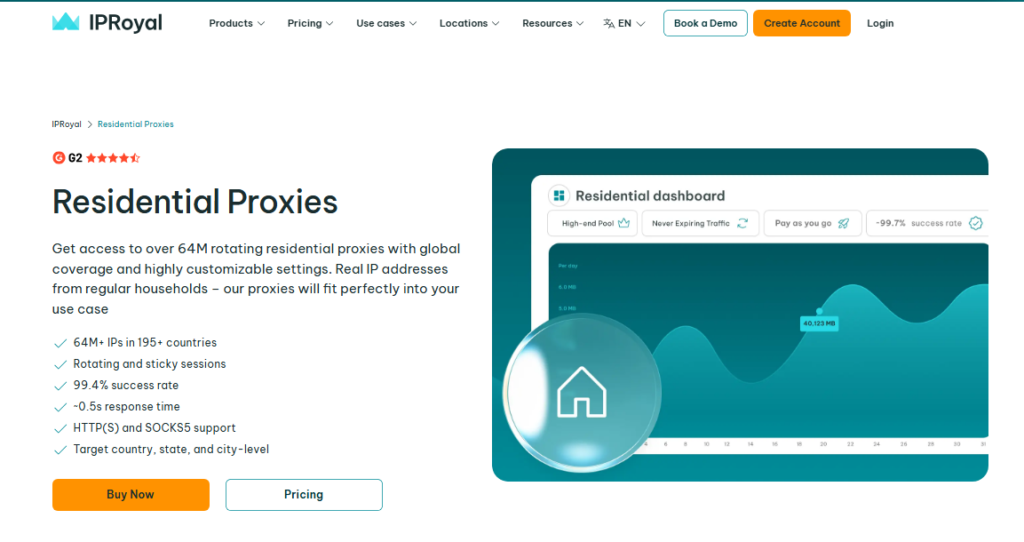
If your use case is irregular (heavy one week, light the next), this prevents the budget drain of paying for bandwidth you didn’t use.
Speed: Averaged 180 Mbps in my tests.
Success Rate: 95.1% overall.
Best For: Users with irregular or project-based proxy needs.
Pricing: Flexible per GB and per IP options available.
4. NetNut: Best for Rotating ISP Proxies
NetNut takes a different approach to the ISP proxy space by offering both static and rotating options from the same pool.
For large-scale data collection where you need the trust level of ISP IPs but don’t need a fixed identity, NetNut’s rotating setup performs well.
Speed: Averaged 195 Mbps in scraping tests.
Success Rate: 96.2% against protected targets.
Best For: High-volume data extraction with IP rotation needs.
5. Webshare: Best Budget-Friendly ISP Proxies
Webshare sits at the budget end of the ISP proxy market without feeling cheap.
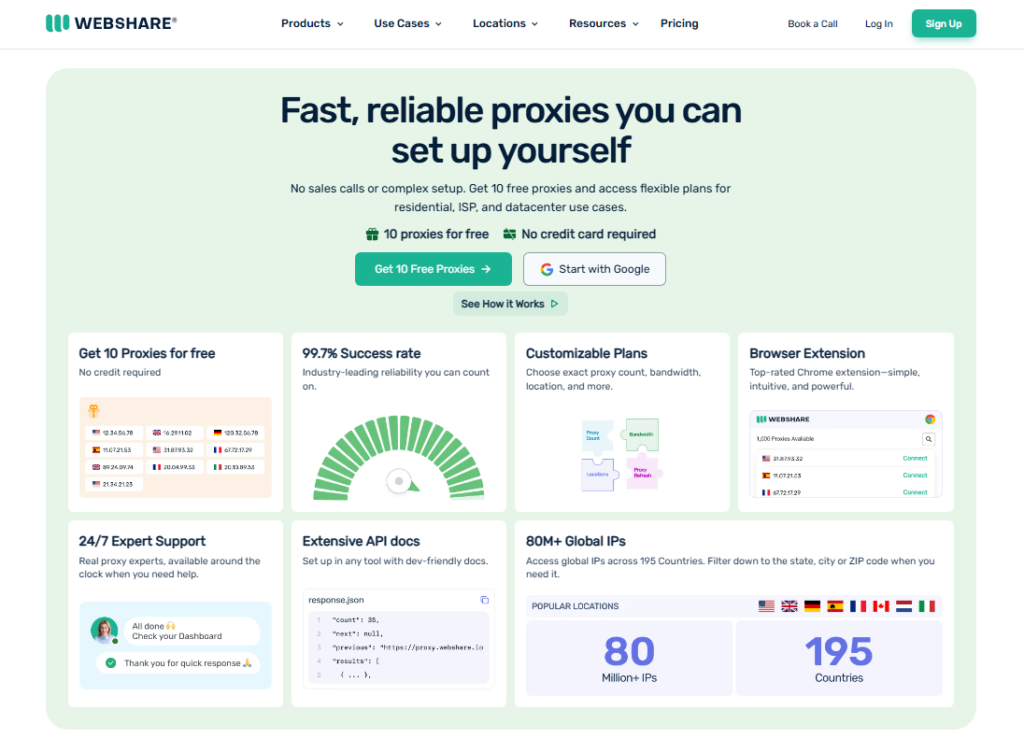
The pool is smaller than Oxylabs or Decodo, but for individual users or small teams running modest operations, the price-to-performance ratio is hard to match.
Speed: Averaged 160 Mbps.
Best For: Solo users, developers testing at low volume.
Pricing: Among the lowest per IP costs I found in 2026.
6. Rayobyte: Best for Flexible Rotation Settings
Rayobyte gives users unusually granular control over rotation settings. You can configure how frequently IPs rotate and tie rotation triggers to specific session behaviors.
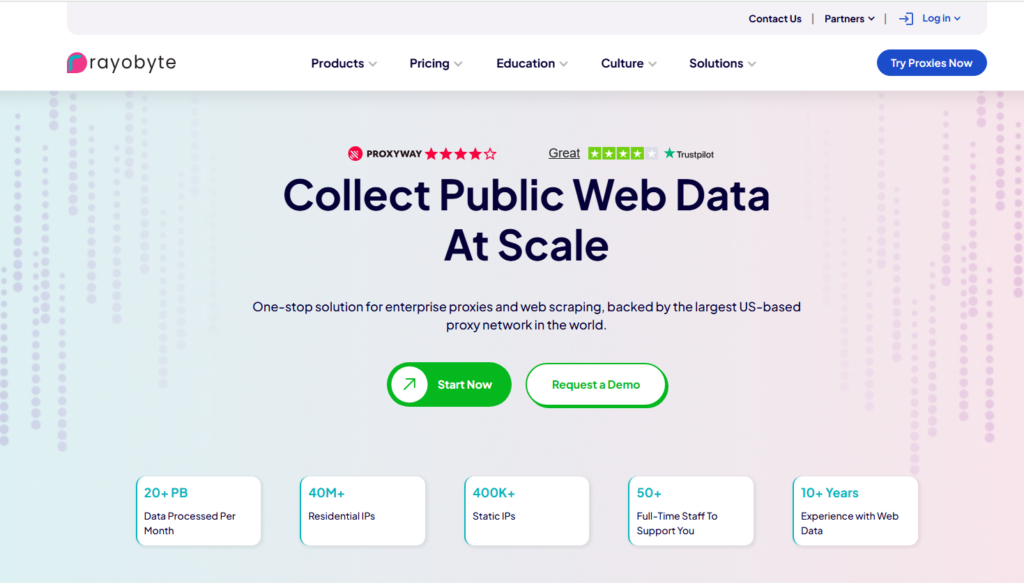
For advanced users who want to fine-tune their proxy behavior, this level of control is rare and genuinely useful.
How to Verify ISP Proxy Quality Before You Buy
This section is what most “best ISP proxies” lists skip entirely, and skipping it is how people waste money. Before committing to any plan, I always run through these four checks.
Step 1: Check the ASN
Run any proxy IP through a tool like ipinfo.io or scamalytics.com. Look at the Autonomous System Number (ASN).
A legitimate ISP proxy should show an ASN belonging to a consumer ISP: Comcast (AS7922), AT&T (AS7018), or similar.
If the ASN resolves to a cloud hosting company like Amazon or Hetzner, you’re looking at a rebranded datacenter proxy regardless of what the marketing says.
Step 2: Test Subnet Diversity
This is the detail that separates quality providers from the rest. Ask any provider directly: “How many /24 subnets will my 100 IPs come from?” A good provider answers this without hesitation.
The ones that dodge the question are usually cramming hundreds of IPs into a single subnet, which means websites can block your entire pool by blocking one subnet range.
I asked this question to every provider I tested. The ones with genuinely diverse subnets answered immediately.
Two providers I tested couldn’t give me a straight answer, so I crossed them off my list.
Step 3: Verify Residential Classification
Tools like Scamalytics and ipqualityscore.com rate IPs on a fraud risk scale. Legitimate ISP proxies score below 30 on fraud risk.
Any provider claiming “residential legitimacy” but delivering IPs that score above 50 is not giving you what you paid for. I ran this check on every trial batch I ordered.
Step 4: Run Real-World Performance Tests
Speed tests against neutral servers tell you one thing. Real-world tests against your actual target sites tell you something completely different.
I always run 50-100 requests against the specific platform I intend to use before committing to a monthly plan.
Success rate in real conditions is the only number that matters for your specific use case.
The Subnet Diversity Problem (And How to Fix It)
Subnet diversity is the ISP proxy quality issue that almost no review site explains clearly.
Here’s the plain English version: every IP address belongs to a subnet, a group of addresses sharing the same first three number blocks (like 192.168.1.x).
Websites don’t just block individual IPs. They block entire subnet ranges.
If a provider gives you 100 IPs all sitting in the same /24 subnet, a single ban event can knock out your entire pool at once.
That is the real exposure: one blocking decision by one website can take your whole pool offline at the same moment.
Providers with genuine ISP relationships spread IPs across many different subnets because they source from multiple ISPs and multiple regions within those networks.
When evaluating any provider, ask specifically how many unique /24 subnets their pool covers. Target at minimum one unique subnet per 10 IPs for serious work.
When ISP Proxies Beat Residential Proxies
ISP proxies aren’t always the right answer. Understanding when they outperform other proxy types saves money and frustration.
Use ISP Proxies When:
- You’re targeting sites that block all known datacenter ranges (most sneaker sites, Google, eBay, major retail platforms).
- Your task requires maintaining the same IP address across long sessions: account management, social media scheduling, or long scraping jobs.
- Speed matters and you can’t afford the variability of routing through random home devices.
- You need predictable costs with per IP pricing rather than per GB billing that can spike unexpectedly.
Use Residential Proxies When:
- You need extremely high geographic diversity across hundreds of cities globally.
- Your target requires mobile or carrier-specific IP addresses.
- You’re running tasks where absolute detection resistance matters more than speed.
2026 ISP Proxy Trends Worth Watching
The ISP proxy market shifted noticeably heading into 2026. Three trends are reshaping how providers operate and how buyers should evaluate options.
First: More providers are offering hybrid rotating ISP pools alongside traditional static options.
This expands the use case range significantly, making ISP proxies viable for large-scale scraping, a space that was previously dominated by residential proxies.
Second: Anti-bot systems have become more sophisticated at detecting subnet clustering.
Practically speaking, the providers investing in genuine subnet diversity are pulling further ahead of those relying on large pools crammed into narrow IP ranges.
Third: IPv6 ISP proxies are entering the market at lower price points. The technology is still maturing, but for forward-thinking buyers, it’s worth asking providers about their IPv6 roadmap.
Common ISP Proxy Mistakes (And How to Avoid Them)
After talking with dozens of proxy users and running my own tests, the same mistakes come up repeatedly. Here’s what I see most often and how to avoid each one.
Buying the largest pool advertised: Pool size means nothing if all the IPs cluster in two subnets. Focus on subnet diversity and ASN legitimacy over raw IP count.
Ignoring geographic restrictions: ISP proxies are geographically limited by nature. If you need IPs in 40 countries, ISP proxies won’t serve you well. Residential proxies cover more ground globally.
Skipping trial periods: Most reputable providers offer trials or money-back guarantees. I never skip this step. Real world performance on your specific target site is the only data that matters.
Conflating price with quality: The most expensive provider isn’t always the best.
Two of my top ranked options above cost significantly less than market leaders while delivering competitive or better performance on the metrics that matter for most use cases.
Pricing Breakdown: What You’ll Actually Pay in 2026
ISP proxy pricing follows two main models. Understanding them prevents sticker shock when you see a monthly invoice.
Pay Per IP (Most Common): You pay a flat monthly fee per IP address. Prices range from about $1.50 to $15 per IP depending on the provider, location, and volume.
This model works best when you know exactly how many IPs you need each month. Budget users can start with 10-20 IPs and scale from there.
Pay Per GB (Traffic Based): Some providers charge based on bandwidth consumed rather than IP count.
This model suits irregular users but can get expensive fast on data-heavy scraping tasks. Always estimate your monthly bandwidth needs before choosing a traffic-based plan.
For reference, a realistic budget for a small-scale operation (50 IPs, US locations) runs roughly $100-$300 per month with mid-tier providers.
Enterprise scale operations with hundreds of IPs in multiple locations should expect $500-$2,000 or more monthly depending on the provider and volume.
Frequently Asked Questions About ISP Proxies
What exactly is an ISP proxy and how does it work?
An ISP proxy is an IP address registered under a consumer Internet Service Provider like Comcast or AT&T but hosted on datacenter hardware. The reasoning behind its effectiveness: websites see a residential ISP name in the IP registration data, but the connection runs at datacenter speeds. This combination makes detection significantly harder than with pure datacenter proxies.
Are ISP proxies the same as static residential proxies?
Yes, these two terms refer to the same product in most contexts. Providers use both names interchangeably. The key defining features are the same: IP addresses registered to an ISP, hosted on datacenter servers, with a static (non rotating) assignment that stays consistent across sessions unless you choose to change it.
How do I know if an ISP proxy provider is legitimate?
Check the ASN of sample IPs using a tool like ipinfo.io. Legitimate ISP proxies resolve to consumer ISP networks, not cloud hosting companies. To add to that, ask the provider directly how many /24 subnets their pool spans. Transparent providers answer this question without hesitation. Evasive answers are a clear signal to look elsewhere.
Can ISP proxies get banned by websites?
Yes, they can. No proxy type is completely ban-proof. The risk worth watching is subnet concentration: if your provider clusters many IPs in the same subnet, a single ban can take down your entire pool at once. Choosing providers with strong subnet diversity significantly reduces this risk. Rotating your IPs periodically and mimicking natural browsing patterns also extends proxy lifespan.
Which use cases benefit most from ISP proxies in 2026?
Sneaker copping, social media account management, ad verification, price monitoring on protected retail sites, and search engine scraping are where ISP proxies consistently outperform other proxy types. Practically speaking, any task that needs both speed and residential-level trust without session interruptions is a strong fit for ISP proxies over alternatives.
What’s the minimum budget to get started with ISP proxies?
You can start with as few as 10 ISP proxies through providers like Webshare or IPRoyal for under $30 per month. This is enough to test your specific use case before scaling up. I always recommend starting small, verifying real world performance on your target sites, then expanding your pool based on actual results rather than projected needs.
Final Verdict: Which ISP Proxy Provider Should You Choose?
After weeks of testing and real money spent, my honest recommendation depends on what you’re trying to accomplish.
For most people reading this, Decodo delivers the best balance of performance, price, and ease of use.
Oxylabs is worth the premium if you’re running high-volume US operations and need the best possible success rates at scale.
IPRoyal earns a spot for anyone with irregular usage patterns who can’t afford to waste non-refundable monthly bandwidth.
The one thing I want you to take away from this guide: don’t buy ISP proxies based on pool size or marketing claims alone.
Check the ASN, ask about subnet diversity, and always run a real-world trial before committing to a full monthly plan.
The best ISP proxies for your specific workflow are the ones that pass all four verification steps I outlined above, not the ones with the biggest headline numbers on a sales page.
The proxy market moves fast. Providers that were solid choices 12 months ago may have changed their infrastructure, pricing, or sourcing practices.
What I’ve described here reflects my own testing as of 2026, and I’ll continue running these checks as the landscape evolves.