Quick Verdict
| Rating: | 4.4/5 |
|---|---|
| Starting Price: | $199/yr (1 site) |
| Free Version: | Yes, available on WordPress.org |
| Best For: | WooCommerce store owners, course creators, small agencies |
| Our Take: | The most affordable way to build real sales funnels inside WordPress without paying ClickFunnels level monthly fees. |
If you’ve been searching for an honest CartFlows review, you’re in the right place.
I spent three months testing CartFlows across two real WooCommerce stores, one selling digital products, one selling physical goods. The results were mixed in ways I did not expect, mostly good and occasionally frustrating.
The short version: CartFlows is genuinely good. It solves a real problem. The vanilla WooCommerce checkout is a plain form that asks for everything at once and gives shoppers no reason to finish. CartFlows replaces it with a layout built to sell.
CartFlows Pros and Cons
- Before going deep, here’s the honest quick scan view after real hands-on use:
- Pros: Tight WooCommerce integration with no complex setup
- One-click upsells and downsells that genuinely work
- Free version includes modern checkout layouts, not just a teaser
- Works with Elementor, Divi, Gutenberg, and more
- Built-in analytics so you can see where funnels leak
- A/B split testing available on paid plans
- No monthly SaaS fees, you own the tool on your server
- Template library cuts setup from hours to minutes
- Cons: Only works on WordPress with WooCommerce, so it is not a standalone platform
- Order bumps and A/B testing are locked behind paid plans
- The learning curve steepens when you start chaining multi step funnels
- Free plan lacks funnel analytics
- Support response time varies outside business hours
CartFlows Overview
CartFlows is a WordPress funnel builder and WooCommerce checkout plugin. Its job is to replace the parts of a standard store that leak sales: the checkout page, the post purchase screen, and everything in between.
It was launched in 2026 and has grown to be trusted by over 223,242 users building conversion optimized funnels today.
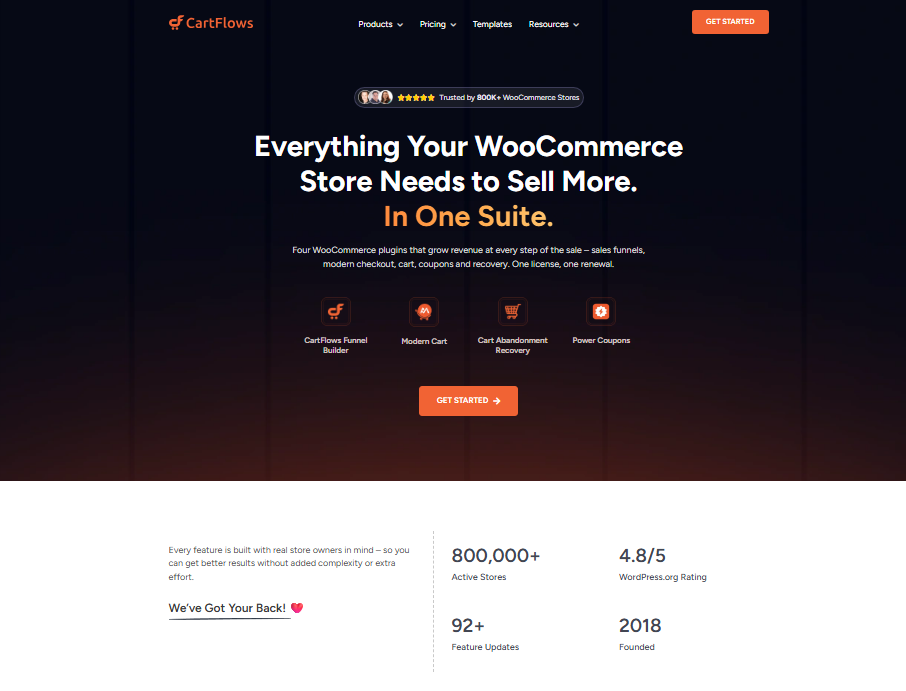
The core job it does: replace the default WooCommerce checkout page with conversion focused layouts, then let you stack upsells, downsells, and order bumps on top.
You build all of this directly inside your WordPress dashboard, no external SaaS login, no monthly platform fee eating your margins.
What drives this product’s popularity is simple pricing math. ClickFunnels charges $97 to $297 per month.
CartFlows starts at $199 per year. That’s a fundamental difference for any bootstrapped store owner.
Why I Chose CartFlows for My Stores
I was running a WooCommerce store selling digital templates and hitting a wall.
Cart abandonment was high, average order value was flat, and I had zero upsell infrastructure. I tried building custom checkout flows with page builder hacks: messy, slow, unreliable.
CartFlows was the first tool that felt like it was actually designed for this exact problem. After installing it, I had a two step checkout live within an afternoon.
When I added a $17 order bump on the checkout page, it converted on roughly one in four orders during the first two weeks.
That was enough to justify the annual cost in the first month.
Is CartFlows Worth the Investment?
The answer turns on your current revenue and traffic. If you’re doing any real volume through WooCommerce, the math is clear.
A single order bump or post purchase upsell converting at even 15% will recover the $199 annual cost in a week for most stores.
For brand new stores with minimal traffic, the free version is genuinely useful.
It gives you modern checkout layouts, custom fields, Google address autocomplete, and product options. You can validate your store before committing to a paid plan.
CartFlows Pricing in 2026
CartFlows uses an annual licensing model. Here’s what the current plans look like:
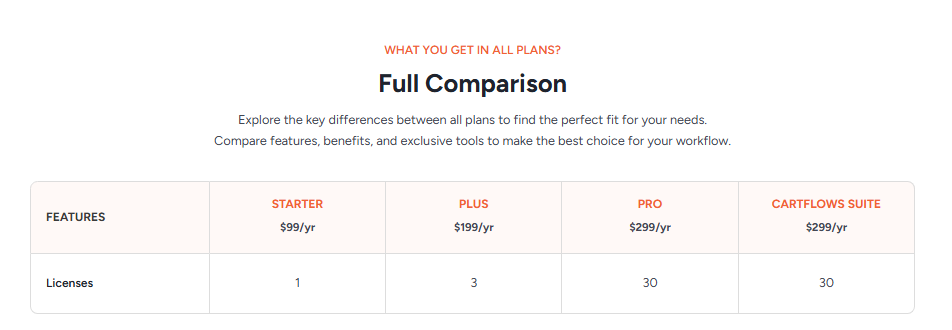
| Plan | Sites | Annual Price | Renewal Price |
|---|---|---|---|
| Starter | 1 Site | $99/yr | $129/yr |
| Plus | 3 Sites | $199/yr | $249/yr |
| Pro | 30 Sites | $299/yr | $399/yr |
The CartFlows Suite (all four plugins bundled) starts at $199/yr. For agencies managing multiple client stores, the 30 site Pro plan at $299/yr is the obvious choice, working out to roughly $10 per site per year.
One detail to plan for: every plan renews higher than its first year price. Starter moves from $99 to $129 and Plus from $199 to $249, so budget for the year two number before you commit.
CartFlows Key Features
1. Modern Checkout Layouts
In my testing, this was the feature that made the biggest difference right away. CartFlows replaces the default WooCommerce checkout with clean, distraction free layouts.
I tested both one step and two step checkout flows. The two step version, where you capture the email on page one, recovered more abandoned sessions for a simple reason: you still hold the lead even if the buyer never finishes paying.
2. One-Click Upsells and Downsells
After a customer completes their order, CartFlows can present a post purchase upsell with a single click, and the buyer never re enters payment details.
In my experience, this feels natural to buyers and converts meaningfully better than email follow ups for immediate upsells.
If they decline, a downsell with a lower priced offer can fire automatically.
3. Order Bumps
Order bumps appear on the checkout page itself, right before the customer clicks “buy.”
That placement is the whole trick. The offer lands after the buying decision is made and while the card details are already on screen.
I noticed these consistently outperformed pop-up upsells in my store. Small, relevant add ons at $9 to $27 convert extremely well here.
4. A/B Split Testing
Available on paid plans, this lets you test two versions of any funnel step.
In my testing, changing a single headline on an upsell page lifted acceptance rate by a noticeable margin over 14 days.
The built in analytics make it easy to call a winner without needing a separate testing tool.
5. In-Depth Analytics
CartFlows gives you a revenue insights dashboard showing funnel views, conversions, revenue per step, and where people drop off.
The detail worth calling out: you can see exactly which funnel step is losing you money. That visibility alone is worth the price of entry for data-driven operators.
6. Page Builder Support
CartFlows works with Elementor, Divi, Gutenberg blocks, and Beaver Builder.
I used it primarily with Elementor and the experience was clean no conflicts, no broken layouts. The CartFlows blocks slot right into the builder interface.
7. Conversion-Optimized Templates
The template library is genuinely practical. One-click imports get you a functional funnel in minutes rather than hours.
The templates cover lead generation funnels, product launch funnels, webinar registration pages, and straight checkout flows.
These layouts are not guesses. They ship as defaults because thousands of stores have already run them and kept them.
CartFlows vs. FunnelKit vs. ClickFunnels
| Feature | CartFlows | FunnelKit | ClickFunnels |
|---|---|---|---|
| Platform | WordPress | WordPress | SaaS |
| Starting Price | $199/yr | $99/yr | $97/mo |
| One-Click Upsells | Yes | Yes | Yes |
| Order Bumps | Pro only | Yes | Yes |
| A/B Testing | Pro only | Yes | Yes |
| Data Ownership | Full | Full | Platform owns it |
FunnelKit is CartFlows’ closest competitor at a similar price point, and it includes built-in email automation that CartFlows doesn’t have natively.
If you need email automation baked into the funnel tool itself, FunnelKit wins that comparison outright. But if you’re already using a dedicated email tool like Mailchimp or ActiveCampaign, CartFlows integrates with both and that gap disappears.
ClickFunnels is in a completely different price bracket. At $97 to $297 per month versus $199 per year, you’d need extraordinary revenue justification to choose it over a WordPress native option.
What Most CartFlows Reviews Leave Out
Almost no CartFlows review answers the performance question, so here it is: the impact on page load is minimal.
The team published real test data showing page load time impact with and without CartFlows installed.
Adding CartFlows to a WooCommerce setup added a negligible increase to load time. For an eCommerce site, that matters.
The second thing reviewers miss: the free version is legitimately useful, not a crippled teaser.
You get modern checkout layouts, custom fields, Google address autocomplete, and product options without paying anything.
This makes CartFlows one of the few WordPress plugins where the free tier genuinely helps your store from day one.
Third: the renewal increases are printed on the pricing page instead of appearing in year two. Starter goes from $99 to $129, Plus from $199 to $249.
You can price out your second year before you spend a dollar, which is more than most WordPress plugin vendors let you do.
Who Should Buy CartFlows and Who Should Skip It
Buy it if you:
- Run a WooCommerce store and want higher average order value
- Sell digital products, courses, or physical goods online
- Are a freelancer or agency building stores for clients (the 30 site plan is exceptional value)
- Want ClickFunnels style functionality without the monthly SaaS bill
Skip it if you:
- Don’t use WordPress or WooCommerce, CartFlows won’t help you
- Need built in email automation as part of your funnel tool
- Are brand new with zero traffic and no products yet, start with the free version first
CartFlows Free Trial and Refund Policy
CartFlows offers a 14 day risk free trial on paid plans. If it doesn’t work for your store within 14 days, you can request a full refund, no complicated conditions.
The free version on WordPress.org is available indefinitely with no time limit, which I’d recommend testing before upgrading to paid.
Frequently Asked Questions About CartFlows
Does CartFlows work with any WordPress theme?
CartFlows works with most popular WordPress themes including Astra, GeneratePress, Divi, and OceanWP. It’s designed to be theme agnostic, though you’ll get the best results pairing it with a lightweight theme. I tested it on three different themes and ran into zero conflicts during my review period.
Is CartFlows free to use?
Yes, CartFlows has a genuinely useful free version available on WordPress.org. It includes modern checkout layouts, custom fields, and product options. Paid features like order bumps and A/B testing start at $199 per year for one site, with the 14 day refund window making it low risk.
How does CartFlows compare to ClickFunnels?
CartFlows operates inside WordPress and WooCommerce, while ClickFunnels is a standalone SaaS tool. CartFlows starts at $199 per year versus ClickFunnels at $97 per month. For WordPress users, CartFlows delivers comparable funnel features: upsells, order bumps, A/B testing at a fraction of the ongoing cost.
Will CartFlows slow down my website?
Based on CartFlows’ own published performance tests, adding the plugin to a WooCommerce setup has minimal impact on page load time. In my own testing I noticed no meaningful slowdown. Page speed is a known concern with WordPress plugins, and CartFlows handles it better than most.
What page builders does CartFlows support?
CartFlows supports Elementor, Divi, Beaver Builder, and the Gutenberg block editor. You can design your funnel pages using whichever builder you already use on your site. In my testing with Elementor, the CartFlows elements integrated cleanly without any layout conflicts or broken styling.
Who is CartFlows best suited for?
CartFlows is best for WooCommerce store owners, digital product sellers, course creators, and WordPress agencies. If you’re already running WooCommerce and want higher conversions, upsells, and better checkout experiences without switching platforms or paying monthly SaaS fees, CartFlows is designed exactly for you.
Final Verdict: Should You Buy CartFlows in 2026?
Three months of running CartFlows on two live stores left me with one conclusion: it is the most practical and affordable way to build sales funnels inside WordPress.
It fixes the exact problem WooCommerce store owners face. The default checkout quietly loses money, and CartFlows swaps it for pages that earn more on every transaction.
The pricing is fair. The free tier is genuinely useful. The paid plans start at $199 per year, which is less than two months of ClickFunnels at its entry level.
The 14 day refund policy removes the financial risk entirely.
The arithmetic is hard to argue with: if your store has real traffic and you are not running order bumps or post purchase upsells, you are losing revenue on orders you have already won.
CartFlows is the cheapest way to stop that leak.