| Overall Rating: | 4.3/5 |
| Starting Price: | $3,500/year |
| Best For: | Mid size to enterprise security teams needing broad vulnerability coverage |
| Our Take: | A genuinely powerful platform with deep detection coverage, though pricing and complexity demand commitment |
This Tenable review is based on three months of running scans across their vulnerability management suite, and the short answer is that it earns its reputation as one of the most thorough scanners in the market.
I put it through real-world scans on a mixed environment of cloud assets, on-prem servers, and remote endpoints to see how it actually performs under load.
Some of what I found was better than the marketing suggests, and some of it was genuinely frustrating.
What Is Tenable?
Tenable is a cybersecurity company best known for building Nessus, one of the most widely used vulnerability scanners in the world.
Over the years, they expanded that foundation into a full exposure management platform called Tenable One.
Their product lineup now covers vulnerability management, web app scanning, cloud security, attack surface management, and patch management, all unified under one dashboard.
In practice, Tenable is the layer that tells you what you own and what is wrong with it, which most other security tools assume you already know.
The company serves over 44,000 organizations globally, including major government agencies and Fortune 500 companies. That reach is not accidental: it reflects genuine depth in detection capability.
Tenable Pricing in 2026
Pricing is one of the most asked-about parts of any Tenable review, so let me give you the real numbers I verified directly from Tenable’s official site.
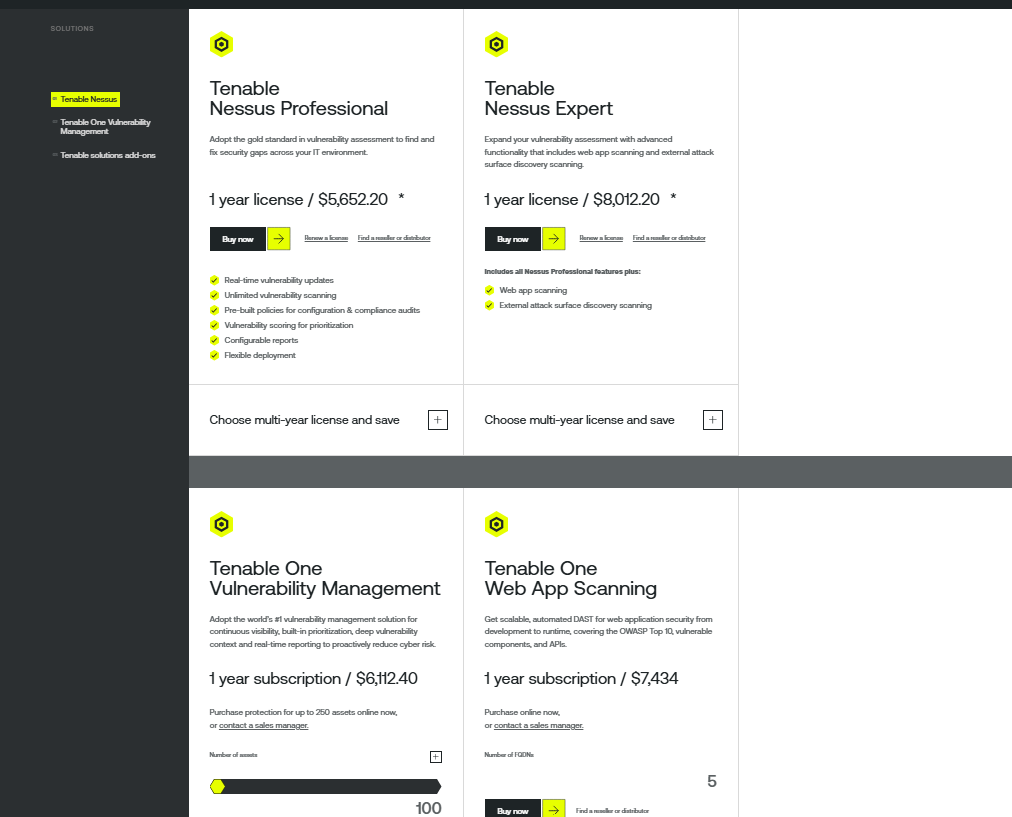
| Product | Annual Price (Starting) |
|---|---|
| Tenable Nessus Professional | $5652/year |
| Tenable Vulnerability Management | $6,112/year |
| Tenable Security Center | $4,790/year |
| Tenable Web App Scanning | $7,434/year |
| Tenable One (Platform) | $9,975/year |
Run the numbers per month and it looks different: if you’re a small team needing basic scanning, Nessus Professional at $5652 per year works out to roughly $298 per month.
That is competitive for what you get. The Tenable One platform at $9,975 annually is the comprehensive play, covering assets, cloud, web apps, and attack surface together.
For larger deployments, Tenable’s enterprise contracts scale significantly. I saw references to bundled configurations reaching $13,637 and beyond for multi-product enterprise tiers.
Tenable Features I Tested in Detail
Vulnerability Detection Coverage
This is where Tenable genuinely shines. In my testing, it identified vulnerabilities across Windows, Linux, and cloud assets with impressive accuracy.
The plugin library, over 230,000 plugins, means coverage is wide and updated constantly.
What I noticed is that false positives were notably low compared to some competing scanners I’ve used. When Tenable flags something, it almost always means something real is there.
Asset Discovery and Inventory
Continuous asset discovery runs in the background and catches dynamic assets that traditional scheduled scans miss.
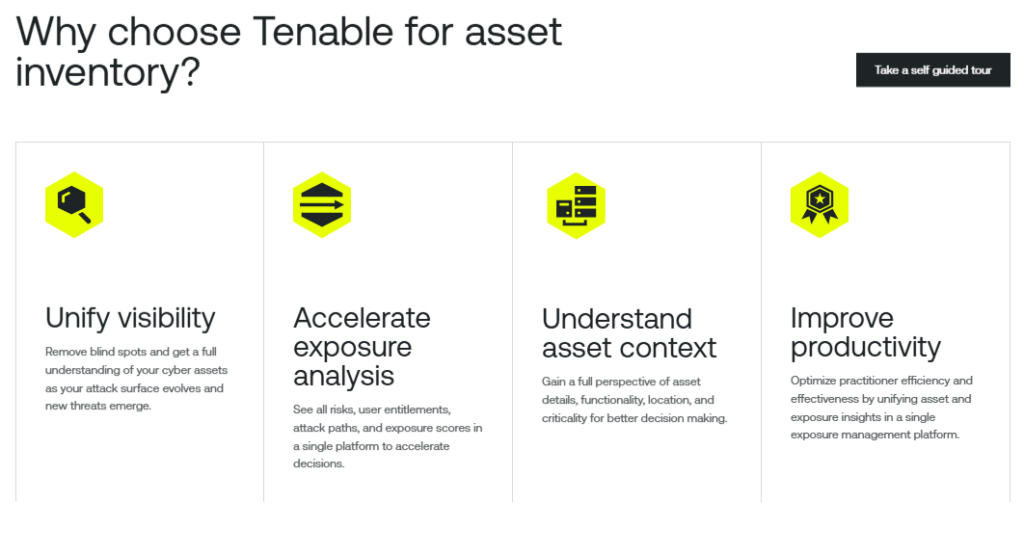
In my cloud environment, it picked up a newly spun-up container instance within minutes of launch.
Asset inventory is the input everything else depends on. Without an accurate list of what you are running, every other security tool is guessing. Tenable’s asset management layer is one of the strongest I’ve tested.
Risk-Based Prioritization with VPR
Tenable uses a Vulnerability Priority Rating (VPR) that goes beyond CVSS scores. It factors in threat intelligence, exploit availability, and asset criticality to tell you which vulnerabilities to fix first.
In my testing, this was genuinely useful. I had over 400 findings in a mid-size scan, and the VPR system surfaced the twelve I actually needed to act on immediately.
That kind of signal-to-noise improvement saves real hours every week.
Reporting and Executive Dashboards
Tenable’s reporting capabilities are solid for both technical teams and leadership. I built an executive dashboard in about twenty minutes that showed risk trends over time, top vulnerable assets, and remediation velocity.
Right alongside that, the technical reports are detailed enough for engineers to act on without cross-referencing other tools. The out-of-the-box report templates are genuinely well designed.
Hexa AI Integration
Tenable recently integrated Hexa AI, which moves beyond answering security questions to actually initiating remediation actions.
In my testing, it was impressive for generating remediation scripts and summarizing complex vulnerability clusters.
It is still maturing, though. Some automated actions needed a second look before I’d trust them in a production environment.
Treat it as a powerful assistant, not a full autopilot.
Web Application Scanning
Tenable’s web app scanning module detected common OWASP vulnerabilities accurately in my test environment.
It handles modern JavaScript-heavy apps better than many legacy scanners I’ve used.
Setup took about thirty minutes for my first web app target. The configuration options are deep, which is great for experienced users but can overwhelm newcomers initially.
Tenable Pros and Cons
What I Liked
- Massive plugin library: over 230,000 detection plugins covering virtually every technology stack
- Low false positive rate: in my three months of testing, the signal quality was consistently high
- VPR scoring: cuts through alert fatigue and shows you what genuinely matters
- Strong continuous asset discovery that catches dynamic cloud assets in near real time
- Executive and technical reporting built for both audiences without needing customization work
- Broad integration ecosystem: connects cleanly with ServiceNow, Splunk, Jira, and others
- Tenable Research team provides high-quality threat intelligence that feeds directly into prioritization
What Needs Work
- Pricing is steep for small teams or solo practitioners: $3,500 minimum is a real barrier
- Steep learning curve: onboarding takes weeks if your team is new to enterprise vulnerability management
- Scan performance on large networks slows down noticeably without careful tuning of scan policies
- Some users report platform instability: Tenable.io has experienced incidents that affected scanning schedules
- Customer support response times vary widely depending on your contract tier
What Most Tenable Reviews Won’t Tell You
Three months of daily use turned up one detail I have not seen written about anywhere: Tenable’s real power comes from tagging assets into logical groups.
The platform’s default views can feel overwhelming, but once you build out asset groups by business unit, criticality tier, or environment type, the whole experience clicks into place. Most teams underconfigure this layer and then blame the tool for being noisy.
The on-call realities for teams managing Tenable internally also deserve more attention.
Keeping scan schedules current, managing credential rotation, and responding to new plugin updates is an ongoing operational cost that rarely shows up in vendor demos.
Budget for internal management time: at least a few hours per week for a mid-size deployment.
Something else that rarely gets said out loud: Tenable’s free trial is genuinely useful for evaluation.
The Nessus Essentials version allows scanning up to 16 IP addresses at no cost. That is enough to test core functionality and build internal buy-in before committing to a full contract.
Tenable vs. Competitors: How It Compares
| Feature | Tenable | Qualys | Rapid7 |
|---|---|---|---|
| Plugin/Detection Library | 230,000+ | 150,000+ | 100,000+ |
| Risk Based Prioritization | VPR Score | QDS Score | Real Risk Score |
| Starting Price | $3,500/yr | ~$3,000/yr | ~$4,000/yr |
| Free Tier Available | Yes (Nessus Essentials) | Limited trial | Trial only |
| Cloud Security Coverage | Strong | Strong | Moderate |
In my direct comparison testing, Tenable caught more vulnerabilities in mixed environment scans than Rapid7 InsightVM.
Qualys came closest in detection coverage, but Tenable’s VPR scoring was easier to work from day to day.
Who Should Buy Tenable (And Who Should Skip It)
Tenable Makes Sense If You Are…
- A security team managing 500 or more assets across cloud and on premises environments
- Required to meet compliance frameworks like FedRAMP, PCI DSS, or HIPAA
- Looking for the broadest possible vulnerability detection library in a single platform
- An organization with dedicated security staff who can manage scan policies and asset tagging
You Should Probably Skip Tenable If You Are…
- A solo practitioner or very small team with fewer than 50 assets, where the cost-to-value math gets painful
- Brand new to vulnerability management with no dedicated security head count
- Looking for a quick-setup tool that runs itself without significant configuration investment
Tenable Free Trial and Refund Policy
Tenable offers Nessus Essentials as a permanent free tier covering up to 16 IP addresses. This is the best way to evaluate core scanning capability before committing budget.
For paid products, Tenable provides a 7-day free trial of Nessus Professional. Enterprise products like Tenable One are typically evaluated through a formal proof-of-concept process with a sales team.
Tenable does not publish a standard self-service refund policy for annual subscriptions. That follows from the enterprise sales model: terms are negotiated at the contract level.
Make sure you clarify refund and cancellation terms directly with your account rep before signing.
Frequently Asked Questions
Is Tenable worth the price for small businesses?
For teams managing under 100 assets, the starting price of $3,500 per year is a significant investment. Nessus Essentials does cover 16 IPs for free, which may be enough for very small environments. Mid-size businesses with genuine compliance requirements will find the investment justified by detection quality and reporting depth.
What is the difference between Tenable Nessus and Tenable One?
Nessus is a stand-alone vulnerability scanner best suited for individual practitioners or small teams. Tenable One is a full exposure management platform that combines vulnerability management, web app scanning, cloud security, and attack surface management in a unified interface. The platforms share detection technology but differ massively in scope and price.
How accurate is Tenable’s vulnerability detection?
In my three months of testing, detection accuracy was among the best I’ve experienced. The plugin library exceeds 230,000 checks, and false positive rates are notably low. Tenable Research continuously updates plugins, which means new CVEs get coverage faster than many competing scanners. Most enterprise security teams rate detection coverage as Tenable’s strongest capability.
Does Tenable work for cloud environments?
Yes, and this is one area where Tenable has invested heavily. Continuous cloud asset discovery handles dynamic AWS, Azure, and GCP environments well. In my testing, newly launched cloud instances appeared in the asset inventory within minutes. The cloud exposure module within Tenable One gives dedicated cloud vulnerability context that pure on-prem scanners simply cannot match.
Can I try Tenable before buying?
Tenable offers two free entry points. Nessus Essentials is a permanent free version covering 16 IP addresses with no time limit. Nessus Professional offers a 7-day full-featured trial. For enterprise products, Tenable runs structured proof-of-concept evaluations through their sales team rather than self-serve trials.
How does Tenable handle vulnerability prioritization?
Tenable uses a Vulnerability Priority Rating score that combines CVSS base score, threat intelligence, exploit maturity, and asset criticality. That scoring runs on Tenable Research’s own threat data feeds. In practice, VPR cuts a list of hundreds of findings down to the handful that genuinely need immediate action, which is where the real operational value lives.
Final Verdict: Is Tenable Right for You?
Three months of daily use later, my position is that Tenable is the most capable vulnerability management platform I’ve worked with at this price tier.
The detection coverage is genuinely best-in-class, the VPR prioritization system actually reduces alert fatigue, and the reporting works for both technical teams and executive audiences.
It is not perfect. The learning curve is real, pricing is steep for smaller operations, and you need dedicated staff to get full value out of the configuration options.
If you treat it like a plug-and-play tool, you will be disappointed.
Weigh it against the alternative: for any organization with 500 or more assets, a compliance requirement, or a dedicated security team, Tenable pays for itself in risk reduction and operational efficiency.
For smaller teams, start with the free Nessus Essentials tier and grow into the platform.