Looking for an honest, no fluff Coursera review? You landed in the right spot.
After spending several weeks testing Coursera Plus, completing courses, and comparing it against Udemy and LinkedIn Learning, here is our unfiltered take: Coursera is one of the strongest platforms for career focused learners who want university backed credentials, but it falls short for casual browsers.
The standout draw is content quality. Courses from Stanford, Google, Yale, and IBM carry real weight on a resume.
75% of Google Certificate graduates report landing a new job, promotion, or raise within six months. That is a stat most competitors cannot match.
Compared to Udemy, where anyone can publish a course (and quality swings wildly), Coursera keeps a tighter lid on standards.
That said, with 350+ partner institutions, not every course on the platform hits the same bar. We ran into a few outdated specializations that felt like they were stuck in [Year].
Last verified: [Month] [Year]. Best for: career changers, upskilling professionals, and students looking for accredited certificates that employers actually recognize.
Quick Verdict and Rating
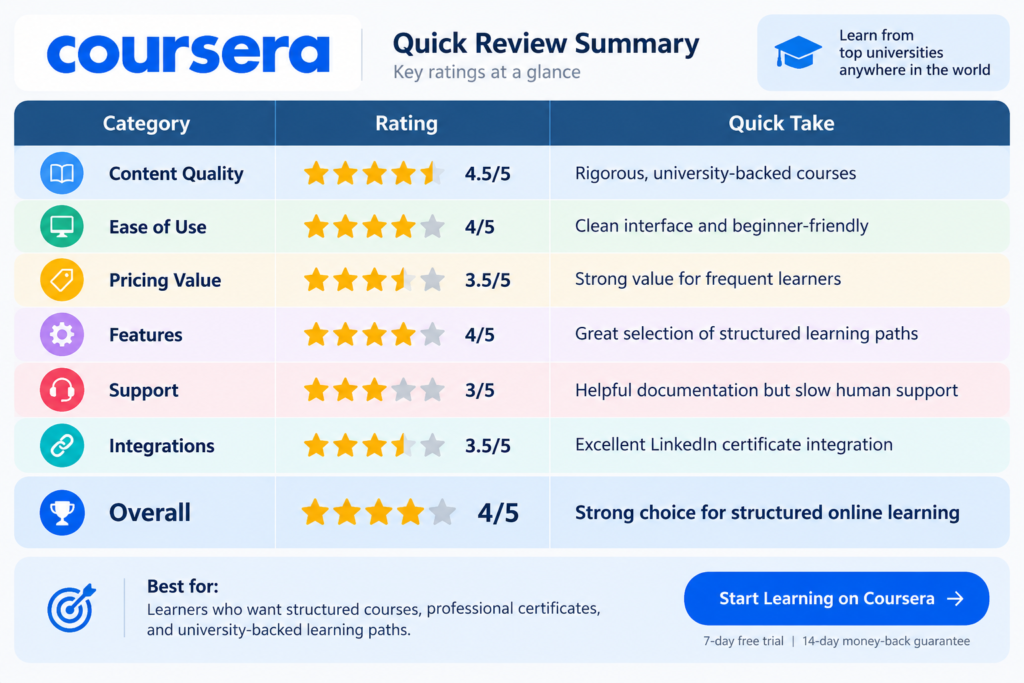
Content Quality: 4.5/5 Best for learners who want rigorous, structured courses backed by top universities.
We tested courses from Stanford, Google, and Johns Hopkins. Production quality was consistently high, with video lectures, peer graded assignments, and hands on projects.
The Google Data Analytics Certificate alone delivers more practical value than most bootcamps at a fraction of the cost.
Ease of Use: 4/5 Best for beginners and non technical users. The dashboard is clean, progress tracking works well, and the mobile app is solid for watching lectures on the go.
Sign up to first lesson took under 3 minutes in our testing. The only friction: navigating between individual courses and specializations can get confusing.
Pricing Value: 3.5/5 Best for learners planning to complete 2+ certificates in a year.
At $59/month or $399/year for Coursera Plus, the value depends entirely on how much you use it.
If you finish one Google Certificate ($200+ standalone value) plus one specialization, the annual plan pays for itself.
Features: 4/5 Best for structured learners who want guided paths. Coursera offers Professional Certificates, Specializations, guided projects, and full degree programs.
Where it falls short: no lifetime access to courses (unlike Udemy), and offline access requires the mobile app on a paid plan.
Support: 3/5 Best for self reliant learners. Help documentation is thorough, but getting a human response takes time.
Trustpilot reviews consistently flag slow support responses, especially around billing disputes.
Integrations: 3.5/5 Best for professionals building a LinkedIn profile. Certificates can be shared directly to LinkedIn, which is a genuine advantage when job hunting.
Missing: deeper integrations with portfolio tools or GitHub for tech learners.
Ready to test it risk free? Coursera offers a 7 day free trial and a 14 day money back guarantee on annual plans.
What Is Coursera and Who Is It For
Coursera is an online learning platform founded in [Year] by Stanford University professors Andrew Ng and Daphne Koller.
It partners with over 350 universities and companies, including Google, IBM, Meta, Yale, Johns Hopkins, and the University of Michigan, to deliver courses, specializations, professional certificates, and full online degrees.
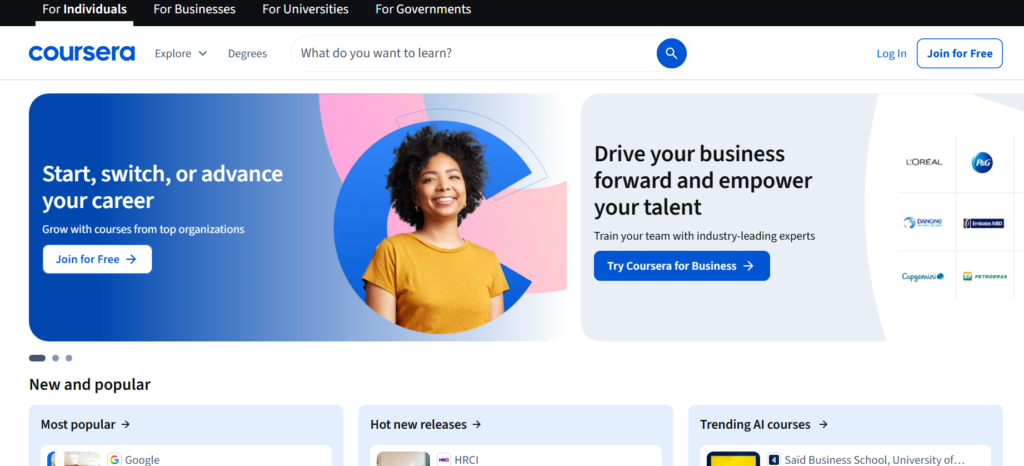
In plain terms, Coursera sits between free YouTube tutorials and expensive university programs.
It bridges that gap by offering structured, accredited learning paths at a fraction of traditional education costs.
The core problem it solves: giving working professionals and career changers access to credentials from institutions they otherwise could not afford or attend.
The platform targets three main groups. Career changers looking for employer recognized certificates (Google, IBM, and Meta certificates lead here).
Working professionals who need to upskill without quitting their jobs. And university students who want to supplement their degree with practical coursework.
If you are a hobbyist looking for one off tutorials on niche topics, Udemy or Skillshare is probably a better fit.
Pricing and Plans Breakdown
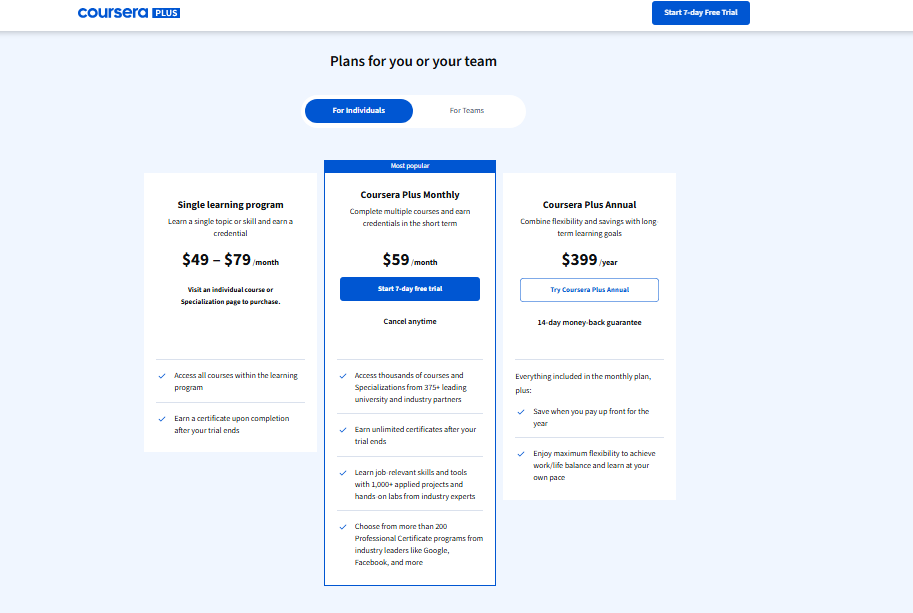
| Plan | Price | Billing | Eff. Monthly | Best For |
|---|---|---|---|---|
| Free (Audit) | $0 | N/A | $0 | Sampling lectures |
| Single Course | $49-$79 | Monthly | $49-$79 | One specific skill |
| Plus Monthly | $59/mo | Monthly | $59 | Short term, 1-2 courses |
| Plus Annual | $399/yr | Annual | $33.25 | Serious learners, 2+ certs |
| Guided Projects | From $9.99 | One time | N/A | Quick hands on practice |
Coursera vs Competitors
| Platform | Starting Price | Standout Feature | Key Limitation | Verdict |
|---|---|---|---|---|
| Coursera | $59/mo | University backed certs | No lifetime access | Best for credentials |
| Udemy | $9.99 (sale) | Lifetime access | No accreditation | Best for budget |
| LinkedIn Learning | $29.99/mo | LinkedIn integration | Less depth | Best for professionals |
| edX | $50+ per course | Harvard/MIT courses | Expensive programs | Best for academic rigor |
Value Stack: The annual Coursera Plus plan at $33.25/month effective cost unlocks thousands of courses and certificates.
If you complete just one Google Professional Certificate (standalone value: $200-$300) plus one specialization in a year, you have already recouped your investment.
The math works for committed learners. It does not work if you sign up, watch two lectures, and forget about it.
Hands On Testing and Setup Walkthrough
- Click on our special link to access the Coursera platform
- Visit the Coursera pricing page and select Coursera Plus (monthly or annual)
- Create your account using email or sign in with Google/Apple
- Complete the brief onboarding quiz (learning goals, time commitment, interests)
- Start your first course or professional certificate
In our testing, we went from sign up to watching the first lecture in under 3 minutes. The onboarding quiz is short and actually useful.
It suggested relevant courses based on our career goals rather than just dumping us on a generic homepage.
The dashboard layout is intuitive. Active courses show progress bars, upcoming deadlines are visible at a glance, and the search function works well for finding specific topics.
The mobile app mirrors the desktop experience closely, and downloading courses for offline viewing worked without issues on the paid plan.
Common setup issues: Some users report confusion between enrolling in a single course versus a full specialization.
If a course is part of a specialization, Coursera sometimes defaults to enrolling you in the full specialization (and the associated billing).
Always double check what you are enrolling in before confirming payment.
Refund window: Coursera offers a 14 day money back guarantee on Coursera Plus. Refund requests must be submitted through the browser (not the app).
Guided Projects are non refundable. If you have already earned a certificate, the refund window closes regardless of the 14 day period.
Is Coursera Worth It?
Best for: Career changers pursuing recognized certificates (especially Google, IBM, and Meta certs).
Working professionals who need structured learning paths with deadlines. Students supplementing their formal education with practical skills.
Not ideal for: Hobbyists who want to casually explore topics (audit for free or use Udemy). Learners who need lifetime access to course material (Udemy owns this).
Anyone expecting live instructor interaction (Coursera is primarily self paced with forums).
Break even point: Complete one Professional Certificate and one Specialization on the annual plan, and you have gotten more value than the $399 price tag.
A single Google Data Analytics Certificate takes about 6 months part time and carries standalone marketplace value of $200-$300.
Cost of choosing wrong: Picking the monthly plan ($59/mo) when you plan to learn for 6+ months costs $354 versus $399 for the full year.
The monthly plan only makes sense for short term bursts of 1-3 months.
Our recommendation: If you are serious about completing at least one certificate, go with the annual plan.
Start with the 7 day free trial to confirm the platform fits your learning style before committing.
Key Features: What They Do, Why They Matter
Professional Certificates
Industry recognized credentials from Google, IBM, Meta, and other major companies. Designed to be completed in 3-6 months with a focus on job ready skills.
Hiring managers at companies like Google, Walmart, and Infosys accept these certificates as valid credentials for entry level roles.
Best for career changers and job seekers entering tech, data, or digital marketing fields.
Specializations
Curated series of 3-7 courses that build expertise in a specific area. Each specialization includes hands on projects and a capstone.
They provide depth that single courses cannot match, creating a structured learning path from beginner to proficient.
Best for professionals who want to go deep on one skill area.
Guided Projects
Short, practical projects (under 2 hours) where you work in a cloud based environment with step by step instructions.
Starting at $9.99, they offer low commitment, hands on practice. Best for learners who want to test a tool or technique before investing in a full course.
Online Degrees
Full bachelor’s and master’s degrees from accredited universities, completed entirely online. Prices range from $9,000 to $45,000 depending on the program and institution.
Best for learners who want a traditional degree credential at a lower cost than on campus programs.
Coursera Plus Subscription
Unlimited access to 7,000+ courses, specializations, and professional certificates for one flat fee.
This removes the per course billing friction and lets you explore freely. Best for learners who plan to take multiple courses across different subjects within a year.
Mobile Learning and Offline Access
The Coursera mobile app supports video downloads for offline viewing on paid plans. Lectures, readings, and some quizzes work on mobile.
Best for commuters and travelers who want to learn during downtime without relying on Wi-Fi.
Pros and Cons: Honest Breakdown
Pros
- University and company credentials carry real weight. Certificates from Google, Stanford, and Johns Hopkins are recognized by employers worldwide, unlike generic completion badges from lesser known platforms.
- Structured learning paths keep you on track. Specializations and certificates follow a logical progression with deadlines, peer assignments, and capstone projects that build real skills.
- Free audit option is generous. You can access lectures and readings for thousands of courses without paying. This lets you evaluate content quality before spending anything.
- Annual plan math works for committed learners. At $33.25/month effective cost with access to 7,000+ courses, the per course value is hard to beat if you actually complete what you start.
- Career outcome data is strong. 75% of Google Certificate graduates report positive career outcomes within six months. That is a measurable return on investment.
Cons
- No lifetime access to courses. Unlike Udemy, if your subscription lapses, you lose access to course materials. Your progress is saved, but you cannot review lectures or notes without resubscribing.
- Quality varies across 350+ partners. While top tier courses from Google and Stanford are excellent, some older specializations from smaller institutions contain outdated examples and stale content.
- Customer support is slow. Trustpilot reviews consistently flag billing disputes that take weeks to resolve. Reaching a human agent is difficult, and the chatbot handles only basic questions.
- Subscription billing catches some users off guard. Several reviewers reported being charged after cancellation, especially when enrolled in specializations with recurring billing. Always confirm cancellation through the browser.
Alternatives Comparison
Where Coursera Wins
- Accredited credentials from top universities and Fortune 500 companies
- Structured learning paths with deadlines and peer review
- Full degree programs available entirely online
- Free audit option for thousands of courses
Udemy
Udemy wins on price and flexibility. Courses drop to $9.99-$19.99 during frequent sales, and you get lifetime access to everything you purchase.
The trade off: no accreditation, wildly inconsistent quality (anyone can publish), and completion certificates that carry minimal weight with employers.
Pick Udemy when you want a cheap, self paced deep dive on one specific tool or technique.
LinkedIn Learning
LinkedIn Learning excels for working professionals who want short, skill based courses (most are under 2 hours).
At $29.99/month, it is cheaper than Coursera Plus, and the direct LinkedIn integration means completed courses show up on your profile automatically.
The limitation: courses lack the academic depth and rigor of Coursera’s university backed content. Pick LinkedIn Learning for quick professional development, not career changing credentials.
edX
Founded by Harvard and MIT, edX is the closest competitor to Coursera in terms of academic credibility. Individual courses range from $50 to $300+, and professional programs can run into thousands.
edX offers MicroMasters and professional certificates that some universities accept as credit toward full degrees.
Pick edX when you want the highest academic rigor and are willing to pay premium prices for individual programs.
Frequently Asked Questions
Is Coursera legit and safe to use?
Yes. Coursera is a publicly traded company (NYSE: COUR) founded by Stanford professors and partners with 350+ accredited institutions. Your payment data is processed securely, and the platform complies with standard data protection regulations.
Does Coursera deliver on its promise of career outcomes?
For Professional Certificates, yes. Google reports that 75% of certificate graduates see positive career outcomes within six months. For individual courses, results depend on how you apply the skills and whether the credential matters in your specific field.
Is there a free trial or free plan?
Coursera offers a 7 day free trial for Coursera Plus, which gives full access to all courses and certificates. You can also audit individual courses for free with access to lectures and readings, though graded assignments and certificates require payment.
How does the refund policy work?
Coursera Plus comes with a 14 day money back guarantee. Request your refund through the browser (not the app). You are not eligible if you have already earned a certificate. Guided Projects are non refundable. Refunds typically process within 7-10 business days.
Is pricing transparent or are there hidden fees?
Pricing is mostly transparent, but watch for two things: specializations sometimes auto enroll you into recurring billing, and the monthly plan at $59/mo adds up fast compared to the annual plan. There are no hidden fees beyond the stated subscription costs.
How does Coursera compare to Udemy?
Coursera offers accredited, structured courses from universities and companies. Udemy offers cheaper, self paced courses from independent instructors. Coursera is better for career credentials. Udemy is better for budget-friendly skill building. They serve different purposes.
Can beginners use Coursera without prior knowledge?
Absolutely. Many courses and certificates are designed for complete beginners. The Google IT Support Certificate, for example, assumes zero prior technical knowledge. Coursera labels difficulty levels clearly so you can find courses that match your starting point.
Is customer support responsive?
This is a weak spot. While help documentation is detailed, getting a human response for billing issues or technical problems can take days. Trustpilot reviews consistently flag slow support as a pain point. For urgent issues, community forums sometimes provide faster answers.
Does Coursera work for international users?
Yes. Coursera is available in 100+ countries with subtitles in multiple languages. Some courses offer fully translated content. Financial aid is available for learners who cannot afford the subscription, though approval takes about 15 days.
How often is Coursera updated?
Partner institutions update their own courses. Top programs like Google Certificates are refreshed regularly to match current industry tools. Some older specializations from smaller partners may not be updated as frequently. Check the last update date before enrolling.
Is my data secure and private on Coursera?
Coursera follows standard industry security practices and complies with data protection regulations. Your learning data is used to personalize recommendations. You can manage privacy settings and data sharing preferences from your account settings.
Can I cancel anytime or are there long term contracts?
No long-term contracts. Monthly plans can be canceled anytime. Annual plans lock you in for one year but come with the 14 day money back guarantee. After cancellation, you retain access until the end of your current billing period.
Who should NOT use Coursera?
Hobbyists who want to casually dip into random topics (audit for free or use Udemy). Learners who need permanent access to course materials (Udemy offers lifetime access). Anyone who needs hands on mentorship or live instruction (consider a bootcamp instead).
Final Verdict
Coursera earns its spot as one of the top online learning platforms for one clear reason: the credentials carry weight.
A Google Professional Certificate from Coursera is recognized by employers at Google, Walmart, Infosys, and hundreds of other companies.
That is not marketing fluff. It is a measurable career asset.
The honest weakness you should accept: customer support needs work, and billing practices occasionally trip up users who do not monitor their subscriptions closely.
These are real frustrations, but they do not undermine the core value of what the platform delivers.
Coursera Plus comes with a 7 day free trial and a 14 day money back guarantee on the annual plan.
If you are planning to complete at least one Professional Certificate this year, the risk is minimal and the upside is substantial.
If career growth through recognized credentials matters to you, start your free Coursera trial through our link and see if it fits your learning style. No commitment until you are ready.